
 AI · AI-generated
Soakaways & infiltration shafts
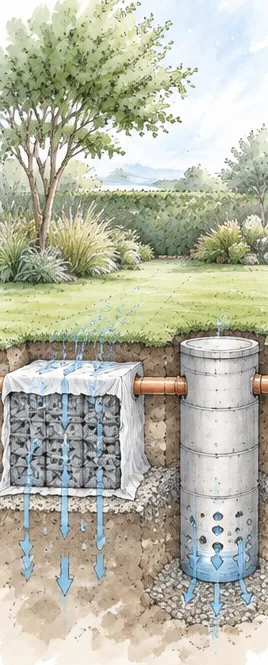
Underground stores beneath lawn, bed or driveway that take in rainwater and let it seep away slowly, sized to suit the roof area and the soil.
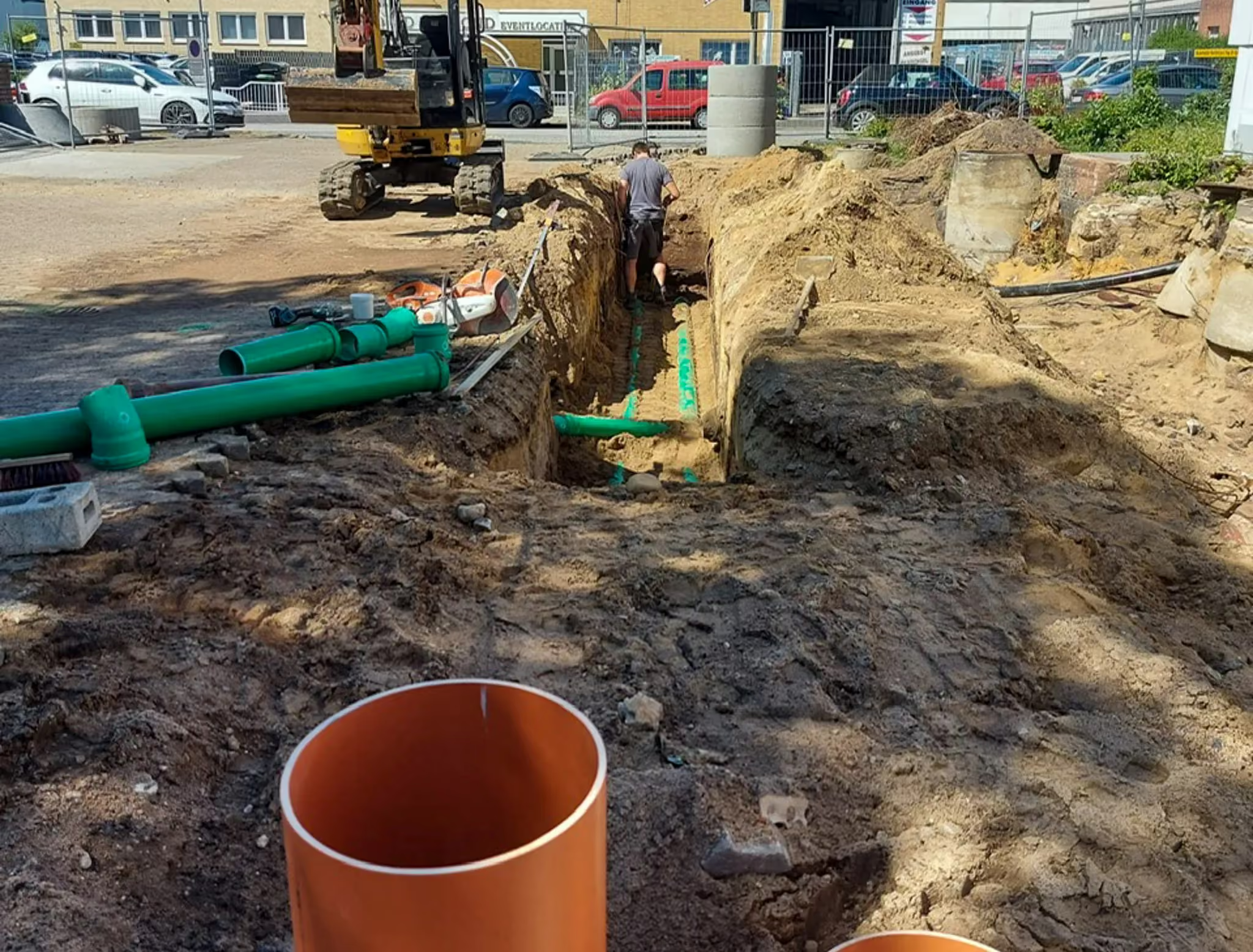
Rainwater belongs in the ground, not on the patio or in the basement. We plan and build soakaways, rainwater tanks and channel drains, connect your gutters and make sure even heavy rain drains away safely.
Roofs, patios and driveways seal the ground. In heavy rain a lot of water collects there very quickly. The sewers are soon overloaded, puddles form on the plot or water presses against the basement wall.
A soakaway catches this water, stores it briefly and releases it slowly into the ground. The water stays where it is needed and helps to recharge the groundwater.
Many local councils actively encourage this. If you let rainwater soak away instead of sending it to the sewer, you often pay a lower surface water charge. For new builds, infiltration is even mandatory in many places.
As a landscaping firm, we tie the drainage in with the garden: channel drains in the driveway and patio, pipes to the downpipe and soakaways under the lawn that nobody sees afterwards.
It starts with a few fat drops on the patio. Ten minutes later the gutters are overflowing, the water is ankle-deep in front of the garage and the basement suddenly smells damp. Summer storms like this are no longer rare in the Hamburg area. In a short time they bring volumes of water that sewers and many plots were never built for.
A soakaway turns this problem into a resource. It absorbs the surge, stores the water underground for a few hours and then releases it slowly into the soil. The garden stays walkable, the basement stays dry and the groundwater is topped up. Combined with a rainwater tank, the rain also becomes free water for the garden in dry weeks.
For years Hamburg has aimed to keep rainwater where it falls wherever possible. The idea is known as the sponge city (Schwammstadt): surfaces should absorb, store and evaporate water instead of sending it straight to the sewer. What swales, green roofs and tree pits do in public spaces also works on a small scale on any private plot. Every soakaway eases the load on the network a little.
From the roof into the ground: these three elements keep the infiltration working in the long term.
 AI · AI-generated
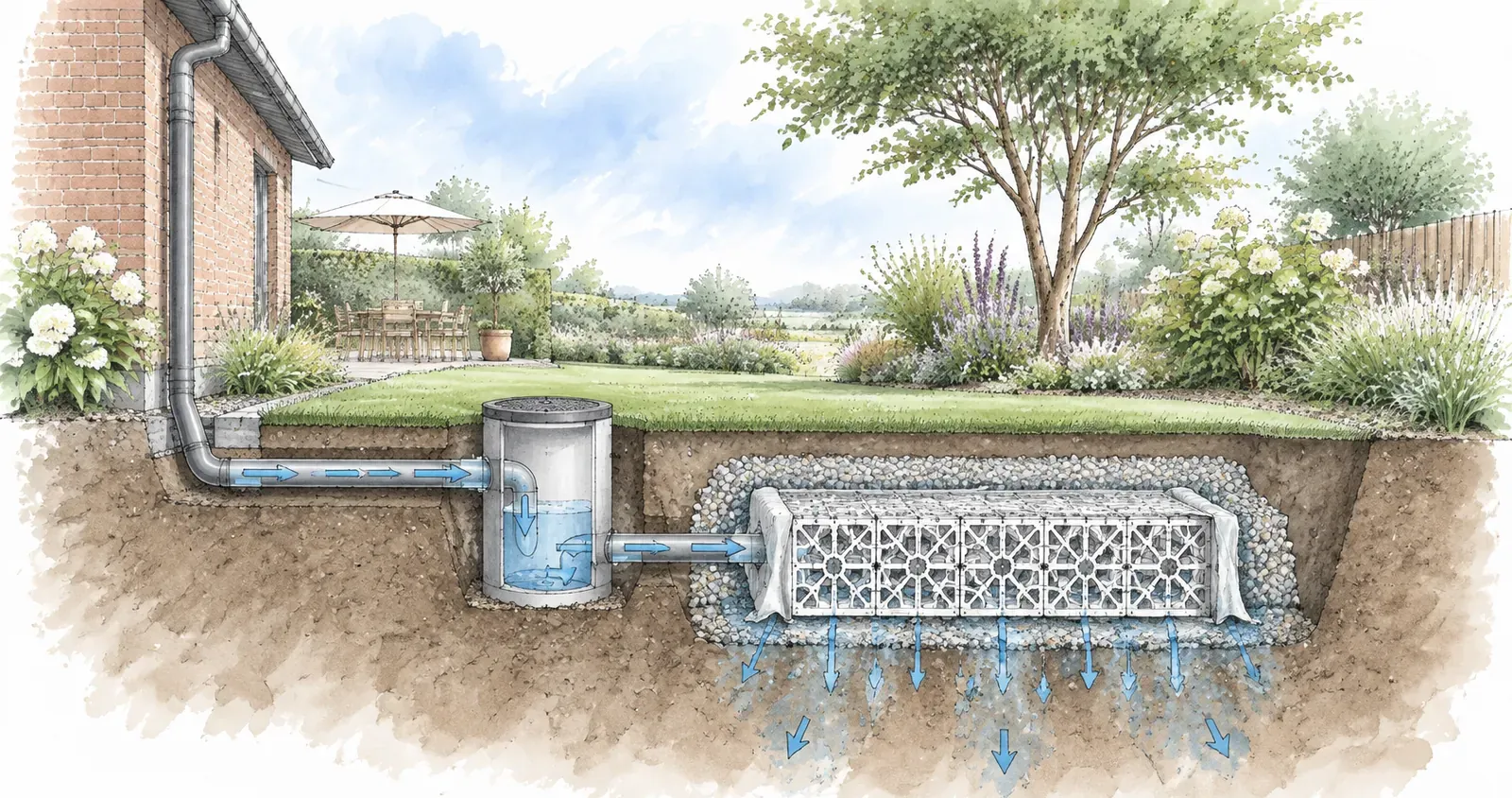
Rainwater from the roof runs through the downpipe and a pipe into a silt trap first, where leaves and dirt settle. From there it flows into the soakaway itself, made of plastic crates. A geotextile keeps the surrounding soil out, and the water seeps slowly into the ground. This only works if the subsoil drains well enough.
Downpipes and channel drains are connected to a pipe. A silt trap or filter chamber holds back leaves and dirt before the water runs into the soakaway.
Plastic crates or coarse gravel form the store. A geotextile wrapped around it stops soil washing in and clogging the soakaway.
The soakaway releases the water slowly into the surrounding soil. For this the soil must drain well enough and there must be a gap above the groundwater.
The size of a soakaway is not a guess. Professionally, it is sized using the standard published by the German Association for Water, Wastewater and Waste (DWA-A 138). Put simply, three figures go into it: the connected area, the rainfall that can statistically be expected where you live, and how permeable the soil is. Specialists call this the kf value.
We check on site whether the soil is suitable, with a simple infiltration test if needed. For larger areas or uncertain ground we recommend a soil survey.
AI · AI-generatedUnderground stores beneath lawn, bed or driveway that take in rainwater and let it seep away slowly, sized to suit the roof area and the soil.
 AI · AI-generated
Underground rainwater stores with a pump that supplies water for the garden. Ideal in combination with automatic irrigation.
 AI · AI-generated
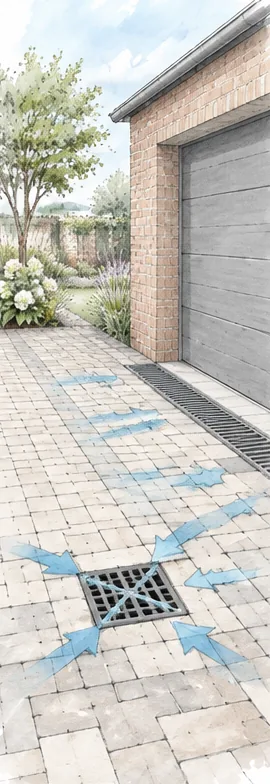
Channel drains and yard gullies in the driveway, on the patio and in front of garages carry surface water away where you want it to go.
 AI · AI-generated
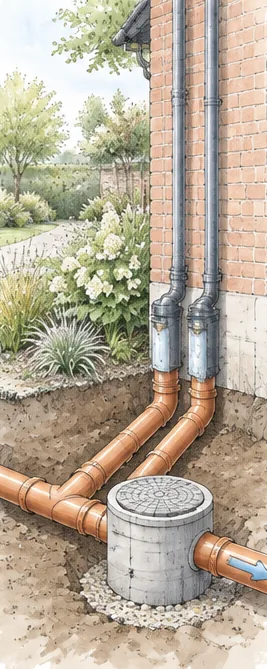
We lay the pipes from downpipes, channel drains and gullies to the soakaway or rainwater tank, with inspection chambers for later maintenance.
 AI · AI-generated
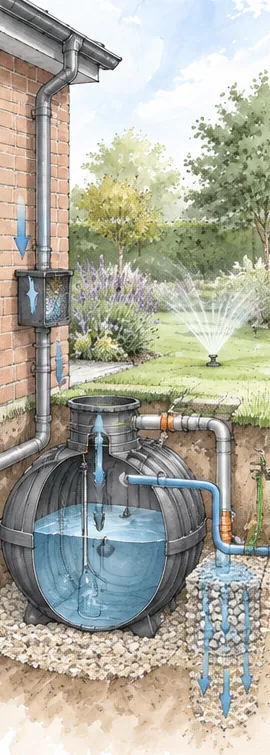
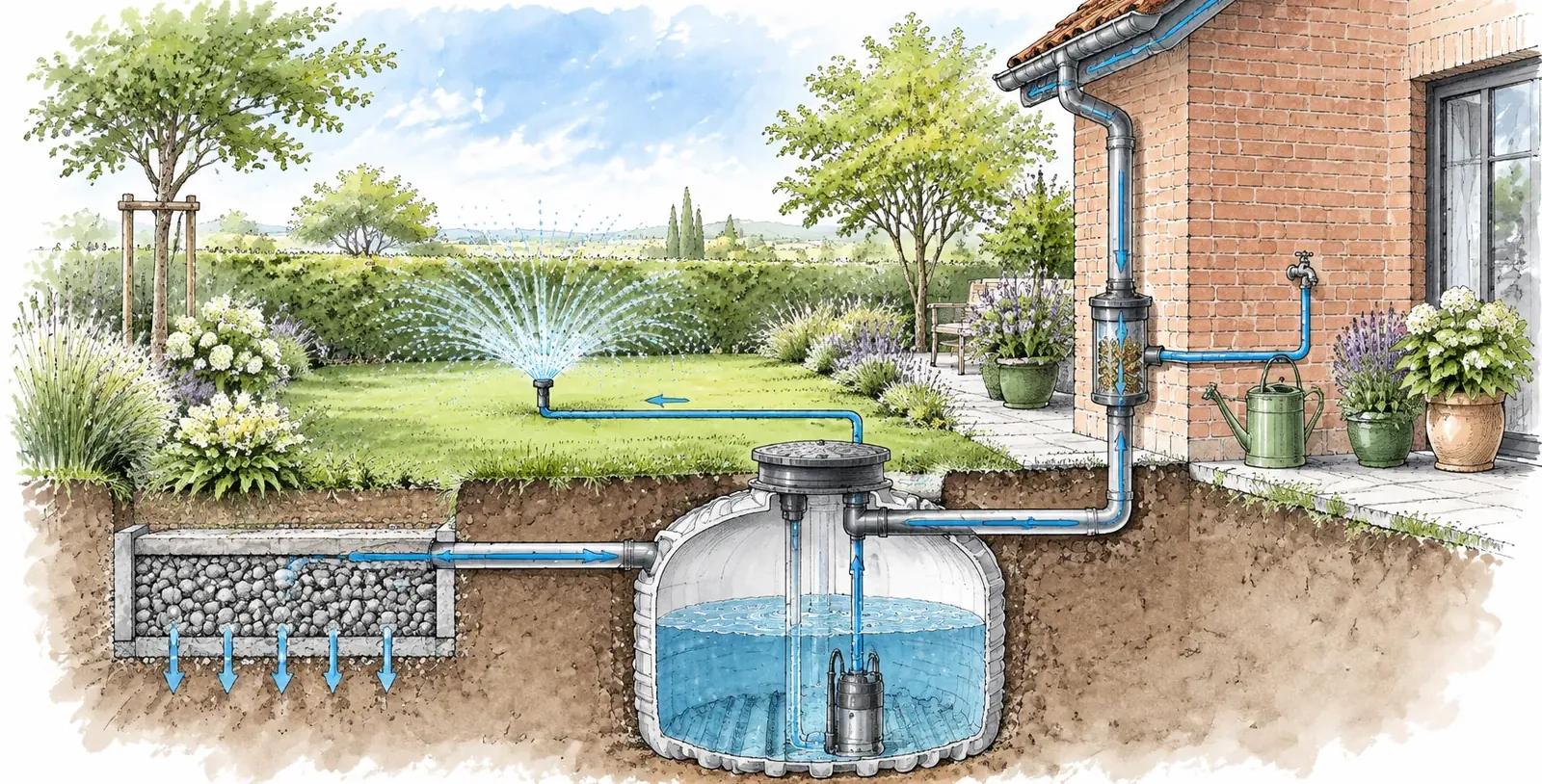
A filter in the downpipe holds back leaves and the water collects in the rainwater tank. A submersible pump supplies the sprinkler and the garden tap. When the tank is full, the water runs through the overflow into a soakaway and seeps away there instead of loading the sewer.
Rainwater from the roof collects in the tank. A pump delivers it to the garden hose or irrigation system. It is lime-free and costs nothing.
When the tank is full, the surplus water runs into the soakaway and seeps away. No rainwater is wasted and the plot stays dry in heavy rain.
Letting rainwater soak away is a matter of water law. In many cases, infiltrating clean roof water on your own plot needs no permit or only has to be notified. Things are different in water protection zones, on contaminated land or when water from surfaces used by vehicles is fed in. In Hamburg the district offices and specialist authorities are responsible, in the Pinneberg district it is the lower water authority (untere Wasserbehörde). We clarify this before work starts.
Financially, infiltration often pays off twice. Hamburg levies a separate surface water charge (Niederschlagswassergebühr) on areas whose rainwater flows into the sewer. If an area is disconnected, the charge falls year after year. Many surrounding municipalities also bill surface water separately.
A worked example as a guide: In the Hamburg area, a 150 m² roof on a detached house receives roughly 110,000 to 120,000 litres of rain a year. With a rainwater tank you can use a good share of that for watering. The rest seeps away in the soakaway.
A soakaway only works if the soil can actually absorb the water. On the sandy geest in the Pinneberg district that is rarely a problem. On clay sites or where groundwater is high, it is. So every plan starts with a simple infiltration test: we dig a pit, fill it with water and measure how quickly the level drops. This figure and the connected roof area tell us how large the soakaway needs to be.
The distance from groundwater is just as important. There should be enough soil between the base of the soakaway and the highest groundwater level to filter the rainwater on its way down. And of course a soakaway needs to be kept away from the house so that no water presses against the basement walls. As a rule of thumb, allow at least one and a half times the basement depth if the basement is not built to be watertight.
Whether you need a permit for infiltration depends on where you are. Hamburg and the municipalities in Schleswig-Holstein have different rules, and the location of the plot matters too, for example in a water protection zone. We work out with you which documents the responsible authority expects and supply the technical details for them.
A combination that gives you more: If you put a rainwater tank ahead of the soakaway, you collect water for the garden first and only the overflow seeps away. Rain becomes irrigation first and groundwater second.
A soakaway works for years, provided it is planned and built properly. These mistakes lead to wet gardens and trouble.
In clay, water seeps away only very slowly. If the permeability is not tested, the soakaway soon fills up.
Leaves and dirt from the roof clog the soakaway over time. A chamber in front of it holds them back and is easy to clean.
If water soaks away right next to the basement wall, it can get in. Soakaways belong at a sufficient distance from buildings with a basement.
A soakaway has to suit the connected roof area and the soil. If it is too small, it overflows in heavy rain.
We look at the roof areas, downpipes, existing pipes and the lie of the land and discuss whether infiltration, a rainwater tank or both makes sense.
We test the soil, size the soakaway to the connected area and find out whether a permit is needed.
We dig the pit for the soakaway, chamber and pipes. The excavated soil is separated cleanly and then removed or reused on site.
We install the geotextile, crates or gravel, chambers and rainwater tank and connect the pipes from downpipes and channel drains.
We backfill and compact the pit and check that all connections are watertight and the water drains away.
We reinstate the lawn, beds or paving. Afterwards there is nothing to be seen of the soakaway.
How large a soakaway needs to be depends on the connected area and how permeable the soil is. Enough distance from groundwater and from buildings with a basement matters too.
Whether infiltration has to be notified or needs a permit varies with the municipality and the location. We clarify this with you in advance and help with the details the responsible authority needs.
Traditional soakaways are trenches filled with coarse gravel. They are robust and the material is cheap, but they need a lot of space because only about a third of the gravel's volume is void space for water. Modern plastic crates, also called soakaway crates, are over 90 per cent void. That means far less excavation for the same storage volume, which is ideal for smaller gardens or beneath lawns and driveways.
You should check the silt trap once or twice a year and remove leaves. With rainwater tanks, the filters are cleaned and the pump is protected before winter.
The costs depend on the connected area, soil type, pipe length and access. A rainwater tank is a separate item. The ranges below are a guide. We give you an exact price after the site visit.
A soakaway can also be added to a finished garden, often under the lawn, which is then relaid. Existing downpipes are simply reconnected.
If you install a rainwater tank at the same time, you have free water for the garden. Our garden irrigation page explains how it can feed an automatic irrigation system.
More on garden irrigation ⟶An underground store made of gravel or plastic crates that takes in rainwater and lets it seep slowly into the ground.
That depends on the municipality and the location. Sometimes a notification is enough, sometimes a permit is needed. We clarify this with you in advance.
Often, yes. If you let rainwater soak away on your plot instead of sending it to the sewer, you can often reduce the surface water charge. The rules are set by each municipality.
In soil that drains poorly, the soakaway has to be larger or combined with a rainwater tank. We check on site whether infiltration is possible.
That depends on the connected area and how permeable the soil is. We size the soakaway for your plot.
Hardly any. The chamber in front of it should be checked regularly and cleared of leaves. Then the soakaway will work for many years.
Yes, with a rainwater tank and pump. Its overflow can be routed into the soakaway, so no water is lost.
In Hamburg, mainly in the west and north, and in the Pinneberg district: Pinneberg, Halstenbek, Rellingen, Wedel, Quickborn, Schenefeld and Tangstedt.
Tell us where it gets wet or where the rainwater should go. We will get back to you and arrange a site visit.