Garden design, patios, natural stone on slopes, paving, turf and automatic irrigation for Niendorf, Schnelsen, Eidelstedt, Lurup, Osdorf and the Elbe suburbs, from a landscaping firm based in nearby Tangstedt.
From our yard in Tangstedt, the north-western and western districts of Hamburg are within easy reach: Schnelsen and Niendorf, Eidelstedt, Lurup and Osdorf, and on to the Elbe suburbs (Elbvororte) of Rissen, Blankenese, Nienstedten and Othmarschen. Here we design and build gardens, patios, paths, fencing and irrigation systems.
Holstein Pflanzen GmbH has been working as a specialist landscaping firm since 2010. Our own permanently employed team works on our sites. That matters in Hamburg, where plots are densely built up and materials often reach the garden by a narrow access path or a flight of steps. Having the same people to talk to and a tidy site is no small thing here.
As a gardening region, west Hamburg is more varied than it first appears. In one street there is a compact terraced-house garden that has to be patio, lawn and privacy screen all at once. In the next there is an old villa garden with rhododendrons, beeches and a natural stone staircase that needs renewing after decades of use.
In short: landscaping for west Hamburg from nearby Tangstedt. Garden design, patios, paving, natural stone, roll-out turf, fencing, rainwater infiltration and automatic irrigation for Niendorf, Schnelsen, Eidelstedt, Lurup, Osdorf, Iserbrook, Sülldorf and the Elbe suburbs. Our own team, a free site visit and a written quote.
Almost all of west Hamburg north of the Elbe lies on the geest (Geest), a sandy upland shaped by the ice ages. Sand and boulder clay typically alternate here, often within a short distance. Whether a soil drains quickly or tends towards waterlogging often only shows once you dig. That is why we check it before we plan the sub-base, drainage and planting.
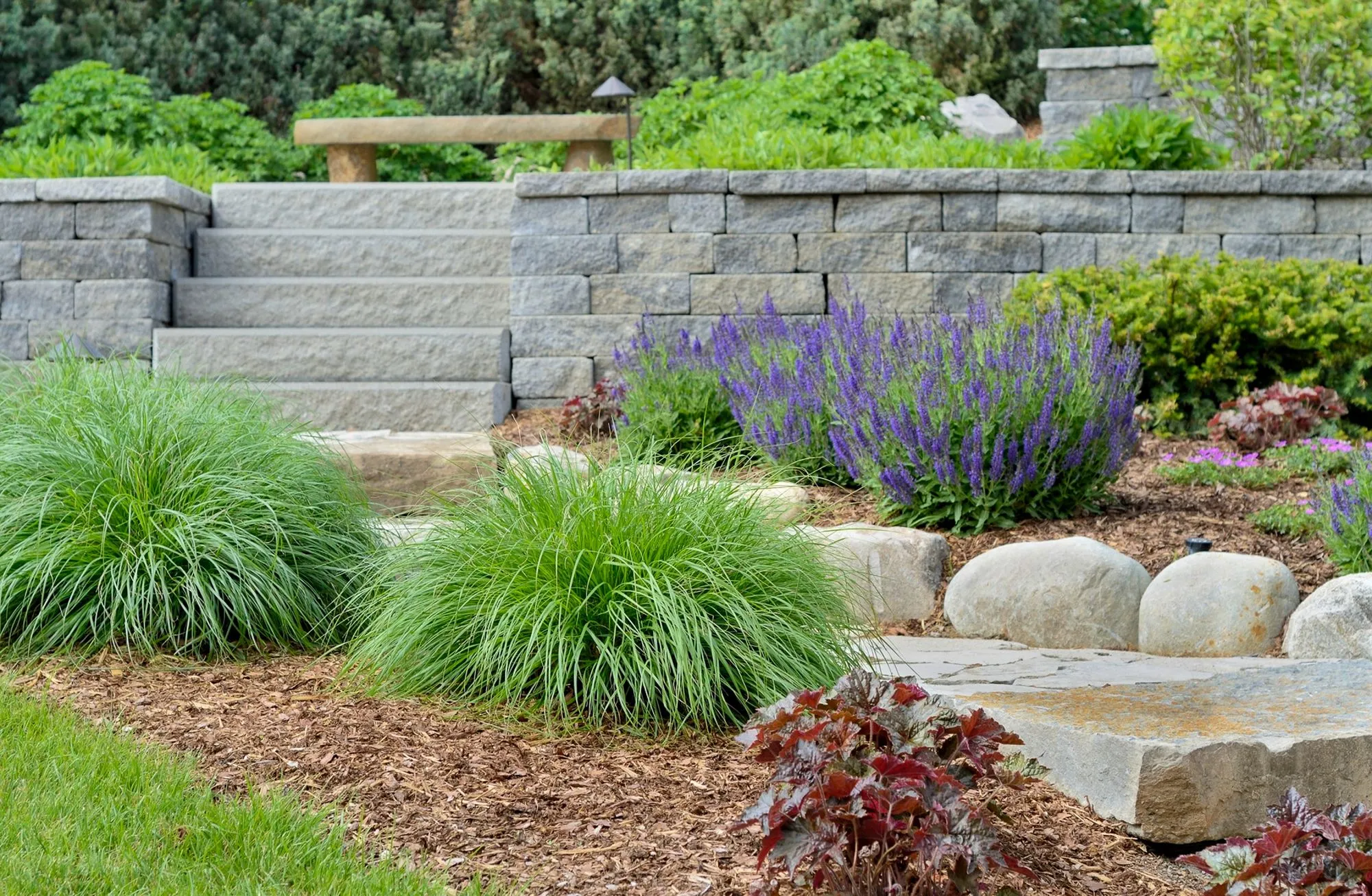
Towards the Elbe, the geest drops away steeply. On the Elbe slope between Othmarschen and Rissen, and especially in Blankenese's Treppenviertel (the “stairway quarter”), many gardens lie on a hillside. Different questions come first there:
On the sandy stretches, for example in parts of Osdorf, Lurup or Sülldorf, dryness is the main issue instead. Beds need humus or mulch, and automatic garden irrigation with drip line and sprinklers keeps lawns and hedges green even in hot summers.
Many gardens here are narrow and deep, often reached only through the house or along a shared path. A lot has to happen in a small space. Clear zones work well: a patio by the house, a compact area of lawn or planting, a privacy screen towards the neighbours and a storage area for bins and bicycles. Ideally each element does more than one job, such as a seating wall that also edges the bed.
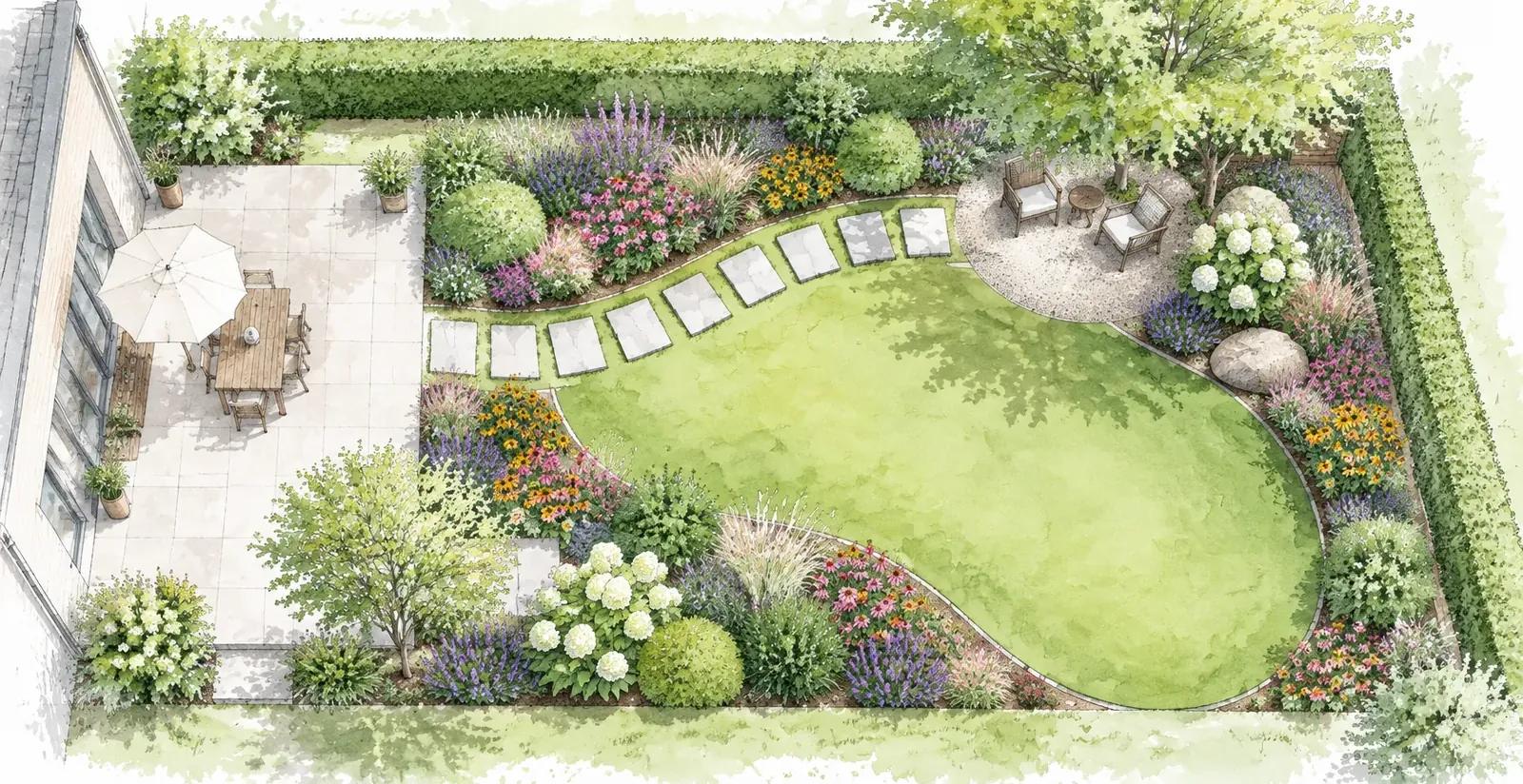 AI · AI-generated
Many gardens in Niendorf, Schnelsen or the Elbe suburbs are long and narrow. A curved lawn, a path of stepping stones and a second seating area at the far end give plots like these depth and make the back of the garden usable.
In Othmarschen, Nienstedten, Blankenese and Rissen, large, mature plots with old trees set the scene. The work here is mostly careful renewal: levelling old clay paver or natural stone paths, enlarging a patio without damaging roots, bringing order back to overgrown areas. We use materials that suit the house and what is already there.
Where new homes go up in Lurup, Osdorf, Iserbrook or Schnelsen, the garden often starts on compacted rubble or made-up ground. Before a lawn or plants can thrive, it needs proper groundworks: loosening or replacing the soil, creating falls, laying conduits. If you plan irrigation, garden lighting and a link to your smart home at this stage, you avoid digging everything up again later.
Hamburg is a green city, and the western districts in particular owe much of their character to their trees. Protection is correspondingly strict. Under Hamburg's tree protection ordinance (Baumschutzverordnung), protected trees include single trees with a trunk circumference of 80 centimetres or more, measured at a height of 130 centimetres, as well as hedges 80 centimetres or taller and certain groups of trees. A permit is needed not only for felling, but also for heavy pruning and for work in the root zone, such as excavating or raising the ground level.
For landscaping, that last point is the decisive one: even a new patio or driveway close to a large tree can need a permit. You apply to the responsible district office (Bezirksamt). For Niendorf, Schnelsen and Eidelstedt that is the Eimsbüttel district office; for the other districts named here it is the Altona district office. The permit often comes with conditions such as planting a replacement tree. In addition, a closed season applies throughout Germany from 1 March to 30 September, during which shrubs and trees may not, as a rule, be removed.
How we handle it: if a protected tree stands in the area to be planned, we raise it at the site visit and plan surfaces and foundations so that the root zone is disturbed as little as possible. The rules can change. The district office gives binding information and also decides on exemptions.
For years, Hamburg has aimed to keep rainwater where it falls wherever possible. Under the name RISA (RegenInfraStrukturAnpassung, the city's rainwater infrastructure adaptation programme), the city is preparing built-up areas for more frequent heavy rain and longer dry spells.
Hamburg Wasser, the city's water utility, calculates the rainwater charge (Niederschlagswassergebühr) from the sealed area connected to the public sewer. Partly permeable surfaces such as grass pavers or block paving with wide joints, green roofs, infiltration swales and soakaways, and rainwater tanks can reduce the area that counts. Hamburg Wasser sets the reduction that applies in each case. When planning new paved areas, it pays to think about this from the start.
In Hamburg, an infiltration system generally needs a permit under water law or a notification. For residential plots, the ordinance on rainwater infiltration (Niederschlagswasserversickerungsverordnung) waives the permit under certain conditions, for example where the connected area is limited and the plot lies outside water protection zones and contaminated sites. A notification is then enough. On sandy soil a soakaway is often the obvious choice. On boulder clay it has to be sized more carefully.
The city supports green roofs through the Hamburg green roof funding programme (Hamburger Gründachförderung), which is handled by the Hamburgische Investitions- und Förderbank (IFB Hamburg). Green garage or carport roofs suit small city gardens well. The programme's duration and conditions can change, so check with IFB Hamburg before you place an order.
In the western districts we carry out every landscaping trade with our own staff. You will find detailed information on the individual service pages:
On older houses, basement waterproofing and a new garden often go together. Whatever has to be dug up anyway comes back as a patio or a bed, all from one firm, with no handovers between contractors.
Our working area in Hamburg stretches from the north-west, on the border with Schleswig-Holstein, down to the Elbe:
| District | Typical projects | What we look out for |
|---|---|---|
| Niendorf | Patios, privacy screens, lawn renewal | Small plots, access often only through the house |
| Schnelsen | New-build gardens, driveways, fencing | Compacted soil, falls and drainage |
| Eidelstedt | Terraced-house gardens, paving, irrigation | Space-saving solutions, close neighbours |
| Lurup and Osdorf | Garden redesign, turf, paths | Varying soils, dry summers |
| Iserbrook and Sülldorf | Garden design, irrigation, soakaways | Generous plots, sandy stretches |
| Rissen and Blankenese | Hillside gardens, steps, natural stone walls | Changes in level, access, tree protection |
| Nienstedten and Othmarschen | Renewing villa gardens, patios, basement waterproofing | Mature trees, conservation ordinances |
We take on neighbouring districts such as Groß Flottbek or Lokstedt on request. For the Pinneberg district there is a separate page on landscaping in Pinneberg.
Most garden work needs no permit. Hamburg does have a few particular rules, though, and we go through them with you at the site visit:
These notes are no substitute for legal advice or official information from the authorities.
Autumn and winter are the best time for planning. Paving and walling can be done almost all year round in frost-free weather. We prefer to lay turf and plant in spring and autumn.
Mainly the north-west and west: Niendorf, Schnelsen, Eidelstedt, Lurup, Osdorf, Iserbrook and Sülldorf, plus the Elbe suburbs of Rissen, Blankenese, Nienstedten and Othmarschen. We also take on work in neighbouring districts on request.
The site visit is free and carries no obligation. Afterwards you receive a written quote.
That depends on the tree. Under Hamburg's tree protection ordinance (Baumschutzverordnung), protected trees include single trees with a trunk circumference of 80 centimetres or more, measured at a height of 130 centimetres. Felling, heavy pruning and any work in the root zone then need a permit from the responsible district office (Bezirksamt). Check with the district office beforehand, as the rules can change.
Yes. On the Elbe slope we build natural stone retaining walls, steps, paths and patios on several levels. We plan drainage and the transport of materials with particular care.
Hamburg Wasser calculates the charge from the sealed area connected to the sewer. Infiltration systems such as soakaways or swales, permeable surfaces, green roofs and rainwater tanks can reduce that area. An infiltration system in Hamburg needs either a permit or a notification. Hamburg Wasser can tell you the exact conditions.
On the sandy geest soils, lawns and beds dry out quickly in summer. An automatic irrigation system with drip line and sprinklers waters precisely, early in the morning, and pauses after rain.
Yes. In Niendorf, Schnelsen and Eidelstedt in particular we often design compact gardens with a patio, privacy screen and lawn. If the garden can only be reached through the house, we agree protective measures with you beforehand.
Yes. Since 2010 we have worked with our own permanently employed team. You deal with the same people from the first appointment to handover.
Is your garden in west Hamburg or the Elbe suburbs? Call us on +49 4101 81 23 692 or send us your enquiry with photos. We will gladly come out for a free site visit and talk through what is possible on your plot.
