DE EN
✉ Get a quote
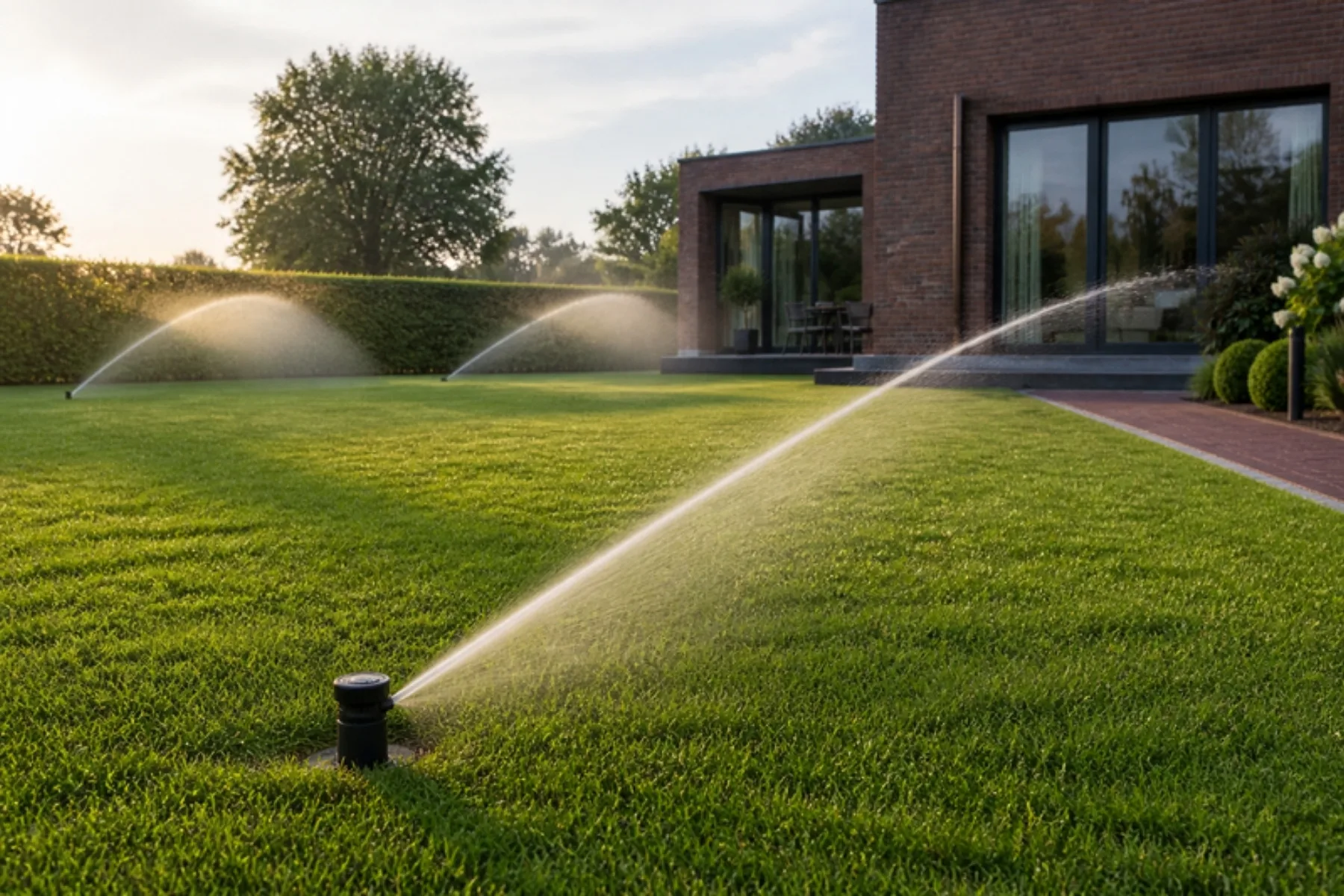
Rotor and pop-up sprinklers water a well-kept lawn in front of a brick house – automatic garden irrigation for Hamburg & Pinneberg
Our specialism

Automatic garden irrigation in Hamburg and Pinneberg

Lawn, beds and hedges get exactly the water they need: early in the morning, controlled by app, with everything hidden below ground. Designed, installed and maintained by a landscaping firm based in Tangstedt.

  • ✓ Planned with a detailed irrigation plan
  • ✓ Installed in existing gardens too
  • ✓ Winterisation & spring start-up
Key points at a glance
  • An automatic irrigation system waters lawns with pop-up sprinklers and beds or hedges with drip line. A controller or an app runs it.
  • Watering happens early in the morning, when the least water evaporates and leaves dry off quickly.
  • A rain or soil moisture sensor pauses the system after rain, so the garden gets only as much water as it needs.
  • The system can be fitted in existing gardens too. Pipes go in through narrow trenches that are gentle on the lawn.
  • In autumn we blow out the pipes to protect them from frost. In spring we start the system up again.

Why automatic irrigation is worth it in northern Germany

Northern Germany has a reputation for rain. Even so, many gardens in Hamburg and the Pinneberg district suffer from drought in spring and summer. Long dry spells have become more common in recent years, and water drains away fast on the sandy geest soils around Pinneberg, Halstenbek and Rellingen. Freshly laid roll-out turf, young hedges and newly planted perennials are especially sensitive to this.

A garden hose rarely makes up for that. Most people water in the evening or in the midday heat, often too briefly and unevenly. Some of the water evaporates, some runs off across paths and the patio, and the roots deeper down stay dry. If you are away on holiday, you hope for rain or for helpful neighbours.

An automatic irrigation system takes this job off your hands. It waters regularly, in the right amount and at the right time, usually in the early morning when there is hardly any wind and little evaporation. The result is a dense, evenly green lawn, healthy plants and far less work for you. Water use falls too, because water only goes where it is actually needed.

As landscapers, we see irrigation as part of a well-planned garden, not as an add-on. That is why we prefer to plan it in from the start: with a new garden, when laying turf or during a redesign. We are equally happy to retrofit existing gardens.

A July morning, and nobody has to fetch the hose

It is just after four, somewhere between Halstenbek and Schnelsen. The street is asleep and the blackbirds are only just stirring. In the lawn, twelve pop-up sprinklers rise quietly out of the ground, sweep their arcs and sink back after a good quarter of an hour. Then the next valve opens. Under the mulch in the perennial bed the drip line starts work, drop by drop, right at the roots. By half past five it is all over. When the family comes out to the patio for breakfast, the paths are dry, the lawn has had its fill and not a drop has evaporated in the midday sun.

This is what a well-planned automatic irrigation system looks like day to day: out of sight, quiet and reliable. It waters according to need, not guesswork. If it rains overnight, the rain sensor tells the controller and the cycle is skipped. When it turns hot, the app extends the run times. If you wish, it does this automatically, using the weather data for your location.

Why irrigation is more than a sideline for us

Many landscaping firms fit irrigation as an extra. For us it is a core part of our work, because it decides whether a garden still looks years later as it did on handover day. We design every system ourselves. On site we measure water pressure and flow rate, divide the garden into zones with similar water needs and draw up an irrigation plan showing every sprinkler, pipe and valve. You receive a copy of this plan, so that ten years from now everyone still knows where each pipe runs.

We fit branded components from established irrigation manufacturers: sprinklers, valves, controllers and sensors that you can still get spare parts for years later. And because a system needs looking after, we remain your point of contact after installation. We start it up in spring, winterise it in autumn and help when a sprinkler has been caught by the lawnmower.

How it is built

How an automatic irrigation system fits together

Every system consists of a few components that are carefully matched to each other. How large each part needs to be depends on your plot, the water source and the plants.

How an automatic irrigation system fits together Water source with filter and pressure reducer, controller with app and rain sensor, solenoid valves and three zones: lawn with pop-up sprinklers, beds with drip line, hedge with drip line. Water sourceControlValvesZone 1: LawnZone 2: BedsZone 3: Hedge Mains supply, wellor rainwater tankControllerwith app & Wi-Fisolenoid valves,one pipe per zonePop-up sprinklersDrip line FilterPressure reducer Rain / moisture sensorpauses after rain All pipes run underground. Only the sprinkler heads are visible while watering.
Infographic: from the water source through the controller and valves to the individual irrigation zones.

Water source

The system connects to the mains supply, a garden well or a rainwater tank. A filter keeps dirt out and a pressure reducer keeps the operating pressure steady.

Control & sensor

The controller sets which zone is watered when and for how long. You can change the times from anywhere using the app, and a rain sensor pauses watering when it rains.

Valves & zones

Solenoid valves open the zones one after another. Lawn, beds and hedges need different amounts of water, so each is controlled separately.

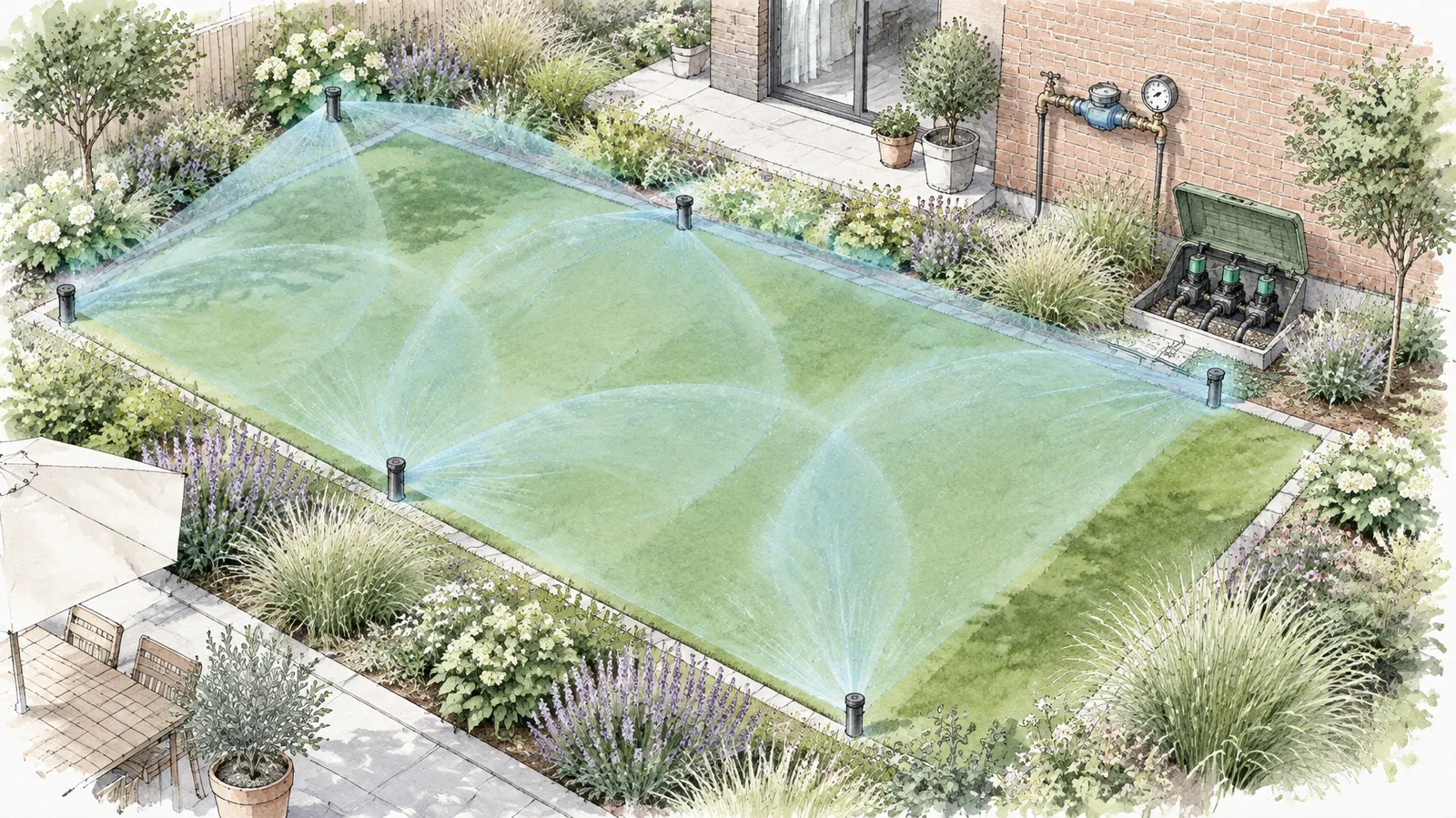
Lawn seen at an angle: pop-up sprinklers at the corners and along the sides, each spray arc reaching the next sprinkler; water connection with meter and pressure gauge at the house, and a valve box with three solenoid valves in the bedAI · AI-generated
Head-to-head coverage

Each sprinkler throws its water as far as the next one. Only this overlap makes sure the edges and the middle get the same amount of water. How many sprinklers a zone can have depends on the pressure and flow rate at the connection. So we measure both before planning and use solenoid valves to divide the garden into suitable zones.

In depth: pressure, flow rate and “head-to-head” coverage

Whether a system waters evenly is decided long before the first trench is dug. It comes down to the hydraulics. Every sprinkler needs a certain minimum pressure, and each zone can only use as much water as the source actually delivers. So before planning we measure at your connection how much water arrives at what pressure. These figures tell us how many sprinklers can run at once and how many zones the garden needs.

On lawns we work to the principle of head-to-head coverage: the jet from each sprinkler reaches as far as the next sprinkler. Only then do the spray patterns overlap enough to avoid dry edges or brown patches in the middle. It is just as important that all sprinklers in a zone have a similar precipitation rate, meaning they put roughly the same number of millimetres of water on the area per hour. That is why a quarter-circle sprinkler in a corner gets a different nozzle from a full-circle sprinkler in the middle.

  • Lawn: pop-up or rotor sprinklers, spaced to match their throw
  • Beds and hedges: drip line under mulch, with emitters 30 to 50 cm apart depending on the soil
  • Pots and raised beds: individual drippers or micro-sprayers on a zone of their own
  • Narrow strips of lawn: strip nozzles, so paths and walls stay dry
Systems

Which irrigation for which part of the garden?

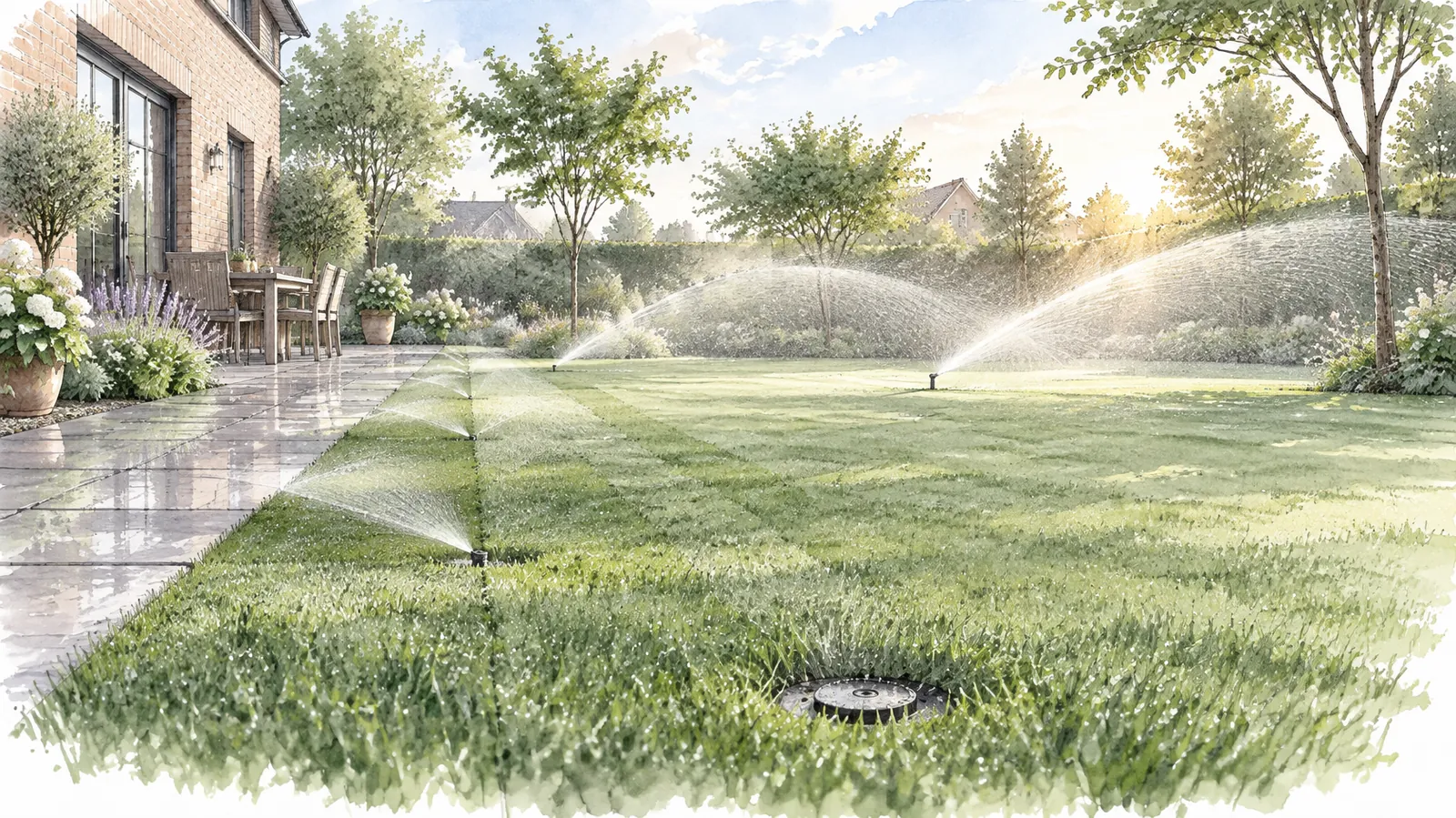
Lawn beside a patio: spray nozzles water the strip along the paving edge, rotor sprinklers the large area, and in the foreground a retracted pop-up sprinkler sits flush with the lawnAI · AI-generated

Lawn irrigation with pop-up sprinklers

Pop-up sprinklers sit flush with the lawn and only rise while watering. Depending on the area, we use rotor sprinklers for larger lawns or spray nozzles for narrow strips and awkward corners. We lay out the sprinklers so that their throws overlap. Only then does the lawn get evenly wet, with no dry edges.

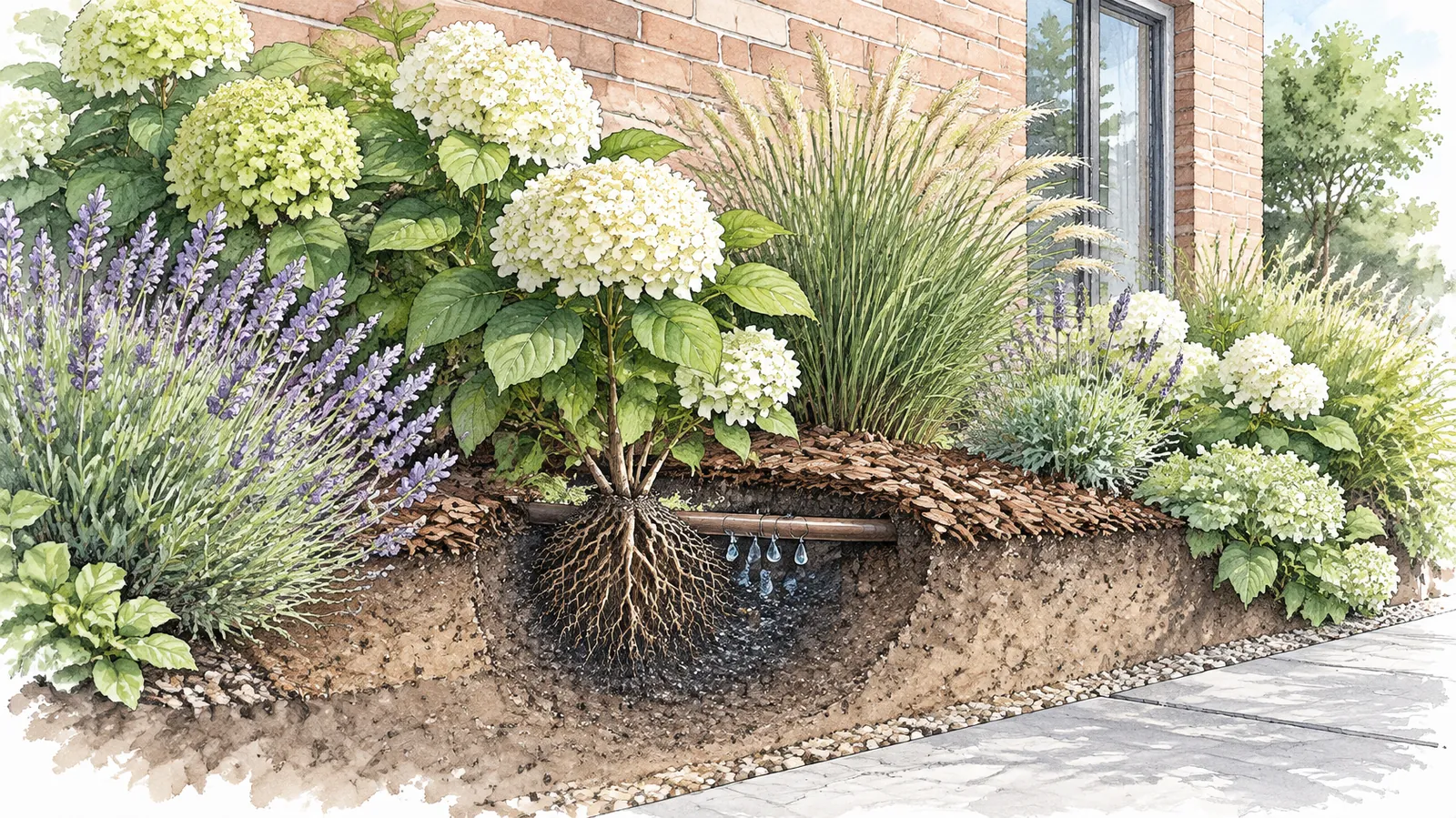
Perennial bed with hydrangeas, lavender and grasses against a brick wall; a cross-section shows the drip line under the mulch delivering water straight to the root ballAI · AI-generated

Drip irrigation for beds

Drip line is the best choice for perennials, vegetables and raised beds. Water reaches the roots drop by drop, leaves stay dry and fungal diseases have less of a chance. Laid under mulch or bark chippings, the line is practically invisible and uses very little water.

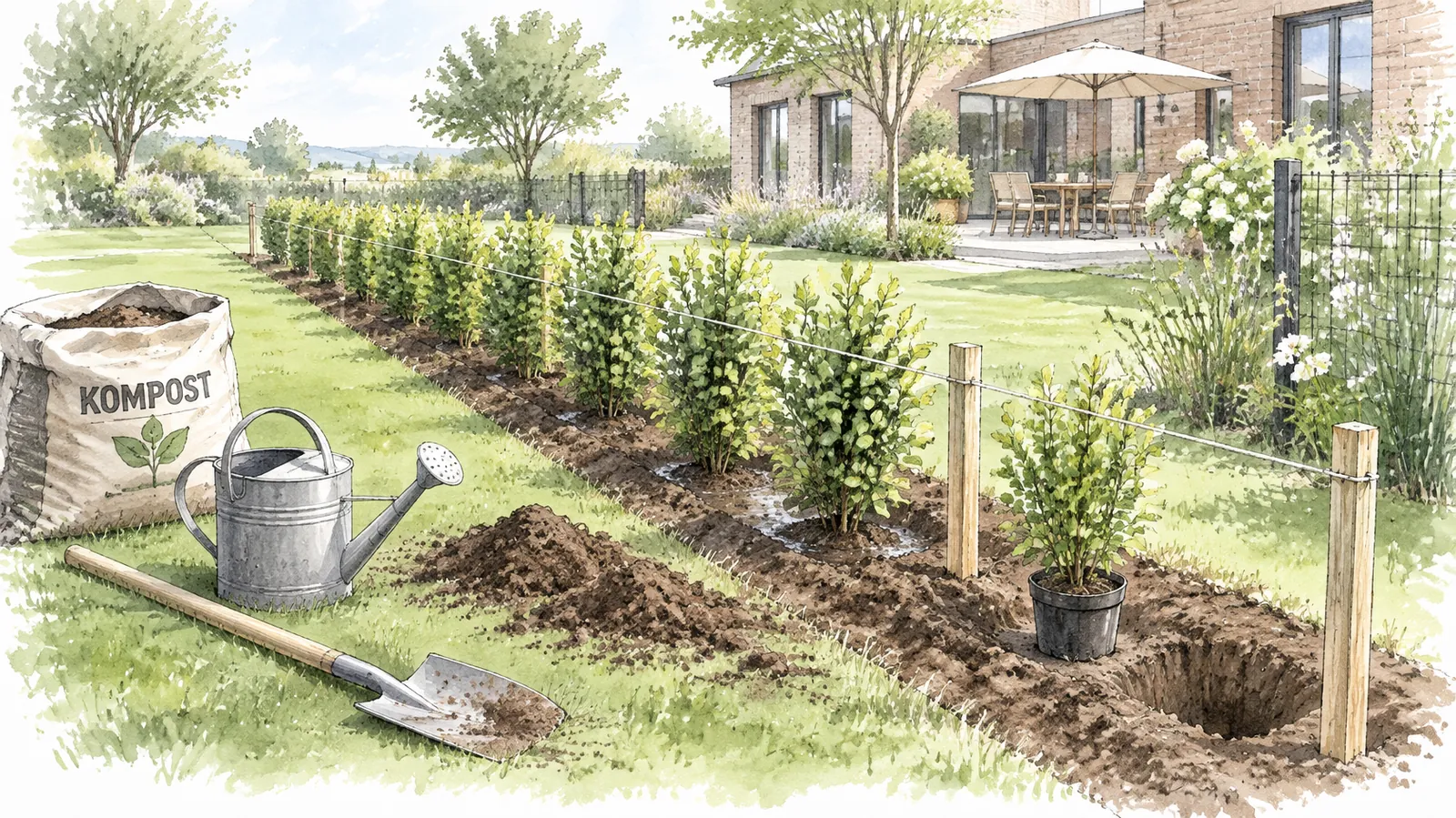
Young hedge plants along a taut planting line on the plot boundary, freshly watered in, with a bag of compost, a watering can and a spade beside themAI · AI-generated

Hedges, shrubs and trees

Newly planted hedges need regular water in their first few years so that they root in well. A drip line along the row keeps cherry laurel, yew or hornbeam reliably supplied, even when you are away in summer.

Roof terrace in evening light with an olive tree and grasses in planters; a thin drip line along the parapet supplies each containerAI · AI-generated

Patios, pots and roof gardens

Planters, window boxes and roof terraces can be connected too. Fine drippers supply each container individually, run on a zone of their own with short, more frequent cycles.

Saving water

How much water does your garden need?

Weekly water requirement in summer, guide values Lawn about 20 to 25 litres per square metre per week, beds 10 to 15, hedges while rooting in 10 to 20, pots and raised beds 15 to 30. 0 10 20 30Lawn 20–25 l/m²Beds & perennials 10–15 l/m²Hedges (rooting in) 10–20 l/m²Pots & raised beds 15–30 l/m²Litres per m² per week in high summer without rain · solid colour = lower limit, light colour = rangeGuide values for water requirements in summer
Infographic: guide values per week in dry summer weather. Actual needs depend on soil, sun, wind and plants.

Water less often, but thoroughly

A lawn grows stronger when it is watered less often but generously. The water then soaks deep into the soil and the roots follow it down. Frequent, short watering keeps the roots near the surface, and the lawn becomes more vulnerable to drought. So the controller splits the weekly amount into a few well-spaced waterings.

Using rainwater and sensors

With a rainwater tank you can use rainwater from the roof for irrigation, which saves drinking water and money. A rain or soil moisture sensor makes sure the system does not water on top of a shower. Modern controllers can also take the weather forecast into account if you wish.

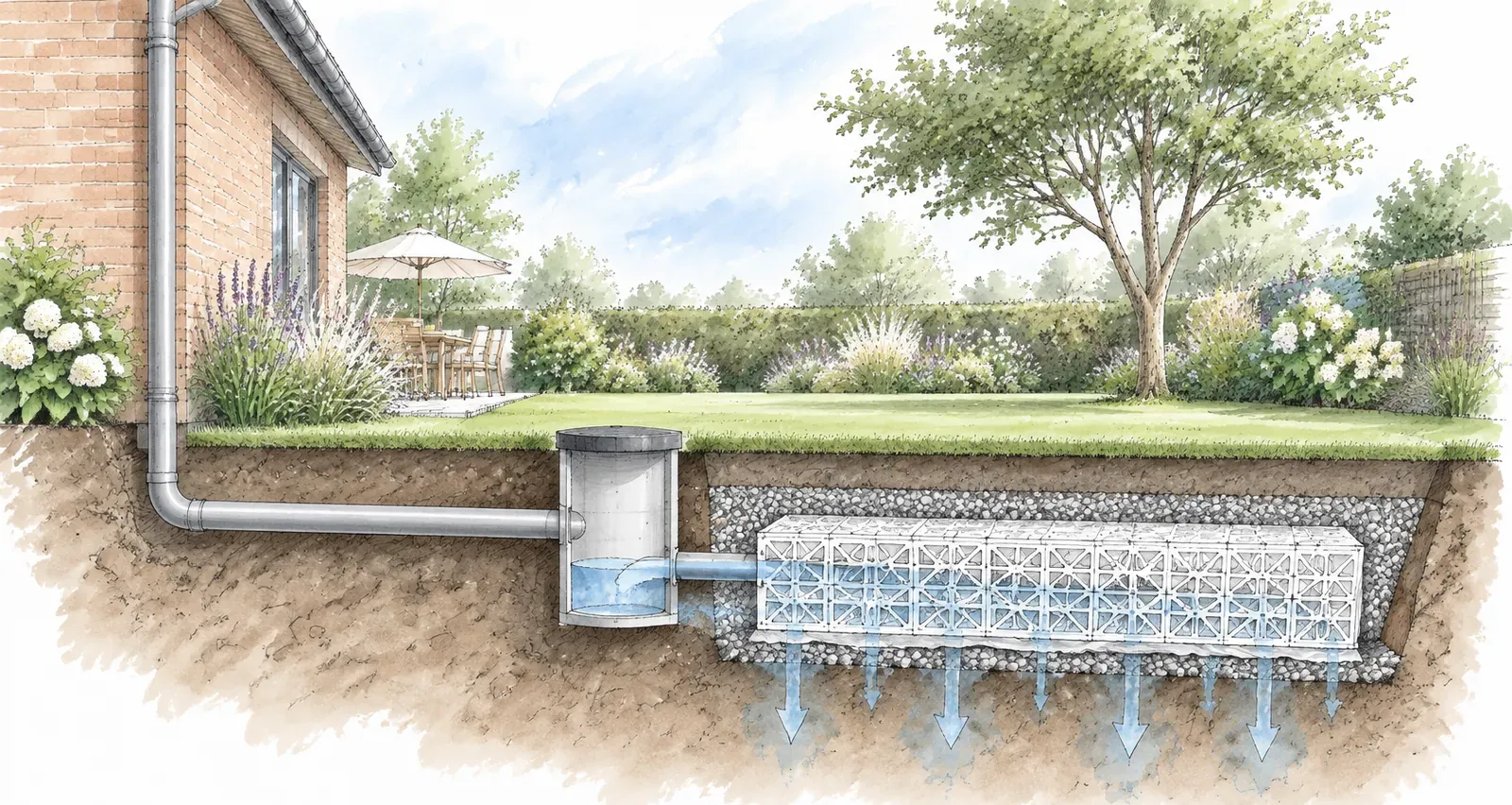
Cross-section beside a brick house: rainwater runs from the downpipe through a settling chamber into a soakaway made of plastic crates in a gravel bed and seeps into the groundAI · AI-generated
Letting rainwater soak into the ground

Whether a soakaway works depends on the soil. Sandy geest soils let rainwater drain away well, while loamy or clay soils do so only slowly. That is why we test the permeability before planning. Where water drains poorly, a rainwater tank can collect part of the rain and make it available for irrigation.

Hamburg, Pinneberg, Tangstedt: what the soil in the north demands

Between the Elbe and the Alster, very different soils lie close together. On the geest, for example in Pinneberg, Halstenbek, Rellingen or Hamburg-Schnelsen, sandy soils dominate. They take up water quickly but hold it poorly, so shorter, more frequent watering cycles make sense here. On loamier ground and compacted new-build plots it is the other way round. Water soaks in slowly, and run times that are too long lead to puddles and run-off onto the paths. There we split the watering into several short cycles so the water has time to soak in.

The water source shapes the design too. Many plots in the Pinneberg district have a garden well, and we check its output beforehand. Iron content and delivery rate decide which filters and sprinklers are suitable. If you have a rainwater tank, you use free rainwater and need a pump with enough pressure. And if you water from the mains, a separate garden water meter can, depending on your water supplier, save you the wastewater charges on the water you use in the garden. We check with you which rules apply in your case.

Rule of thumb: In high summer a lawn in northern Germany needs about 20 to 25 litres per square metre per week. Two or three thorough waterings are better than a little every day. The lawn then roots deeper and copes better with dry spells.

Comparison

Garden hose or automatic irrigation?

Hose & lawn sprinklerAutomatic irrigation
Time neededpulling out and moving the hose every day✓ set once, runs automatically
Watering timeusually evening or midday✓ early morning, little evaporation
Evennessdry corners, wet paths✓ overlapping sprinklers, targeted drippers
Water useoften too much or too little✓ matched to need, sensor pauses for rain
Holidaysasking the neighbours✓ app control from anywhere
Common mistakes

Four common watering mistakes, and how an automatic system avoids them

Many lawn problems such as brown patches, moss or fungal disease are caused by watering the wrong way, not by the seed. These are the mistakes we see most often in gardens around Hamburg:

1

Watering in the midday heat

Much of the water evaporates before it reaches the roots. An automatic system waters in the early morning, when it is cool and still.

2

Too often and too little

Short daily waterings keep the roots shallow, near the surface. A few thorough waterings a week are better, and that is exactly how we programme the zones.

3

Uneven distribution

Portable lawn sprinklers barely reach corners and edges, while paths get wet. Fixed sprinklers with overlapping throws spread the water evenly.

4

Watering despite rain

If you water to a fixed schedule, you often water after a heavy shower too. A rain or moisture sensor then pauses the system automatically.

How it works

Six steps to a finished system

  1. 01

    Site visit

    We look at the plot, water connection, soil and planting, and talk through what you want.

  2. 02

    Irrigation plan

    You receive a plan showing zones, sprinkler positions and pipe runs, along with a transparent quote.

  3. 03

    Installation

    Pipes are laid in narrow trenches and the lawn is neatly reinstated. In new gardens this happens before the turf goes down.

  4. 04

    Commissioning

    We adjust every zone, test the throw of the sprinklers and set up the app together with you.

  5. 05

    Winterisation

    In autumn we blow out the pipes with compressed air so nothing freezes.

  6. 06

    Spring start-up

    In spring we start the system up again and check nozzles, valves and sensor.

Planning

A good plan is half the watering

An irrigation system is only as good as its design. The key figures are water pressure and flow rate at the connection. They determine how many sprinklers can run at once and how the zones are divided. We measure both during the site visit and then specify sprinkler types, nozzles and pipe sizes.

The plants matter just as much. Sunny south-facing areas dry out faster than shady spots under trees, and a lawn needs different watering from a perennial bed. So each area gets its own zone with its own run times. If you are having turf laid, we install the irrigation just beforehand, so the new lawn roots in well from day one.

A year with your system: our maintenance service

Automatic irrigation is not something you install once and then forget. It lives with the garden: hedges grow, beds are redesigned, and after five years a tree casts more shade than planned. Our maintenance service keeps the system in step with those changes.

  • March/April – start-up: fill the pipes, test every zone, align sprinklers, clean nozzles, set the controller for spring
  • Summer – checks as needed: adjust run times for heatwaves, replace damaged sprinklers, check drip lines
  • October/November – winterisation: shut off the water, blow out the pipes with compressed air, switch the controller to winter mode
  • Any time – extensions: connect new beds, pots or an area of lawn later on

Smart control: weather data, soil moisture and leak alerts

Modern controllers connect to your smartphone over Wi-Fi. You can see at any time which zone ran when, and change the times from anywhere. That is handy when you are on holiday and a heatwave is forecast at home. On request we add soil moisture sensors, which only allow watering when the soil is actually dry. A flow sensor also detects unusually high consumption, for instance from a sprinkler head that has been driven over, and shuts the zone off before water drains away unused. That saves water, money and hassle.

Checklist for the first conversation

  • Where is the nearest water connection, and what is the water pressure?
  • Is there a well or a rainwater tank, or is one planned?
  • Which areas should be watered: lawn, beds, hedge, pots?
  • Where is there a power supply for the controller, and is there Wi-Fi in the garden?
  • Are any changes planned in the next few years, such as a new patio?

Maintenance that pays off

A well-maintained system works reliably for many years. Besides winterisation and spring start-up, we can check nozzles, filters and valves on request, adjust run times as plants grow and extend the system when new beds are added.

Costs

What does automatic garden irrigation cost?

The cost depends mainly on the size and layout of your garden. A small lawn with one zone is quicker to complete than a large garden with lawn, beds, hedge and pots. After the site visit you receive a quote listing every item.

ExampleScopePrice range
Small gardenup to approx. 150 m² of lawnfrom approx. €2,800
Family gardenlawn + bedsfrom approx. €5,000
Large gardenseveral zones, appfrom approx. €9,500

What affects the price

  • Size of the areaMore area means more sprinklers, pipes and zones.
  • Layout of the gardenLots of corners, beds and changes in level need more planning.
  • Water sourceA well or rainwater tank may need a pump.
  • ControlA simple controller, or Wi-Fi control with app and sensor.
  • New garden or retrofitInstallation is simpler and cheaper in a new garden.
Get free advice ⟶
Retrofitting irrigation: a pipe is laid in a narrow trench, with turf ready to close it up – Hamburg and PinnebergAI · AI-generated
Retrofitting

Retrofitting irrigation in an existing garden

You do not have to start your garden from scratch to benefit from automatic irrigation. We lay the pipes in narrow slits through the existing lawn and then put the turf back in place. After a few weeks there is hardly anything left to see.

We run conduits under paths and patios, and beds are supplied by drip line under the mulch. Combining the system with a rainwater tank or soakaway makes particular sense: you use rainwater and take pressure off the sewer system at the same time.

More on soakaways & rainwater tanks ⟶
Frequently asked questions

Questions about automatic garden irrigation

What does automatic garden irrigation cost?

That depends on the area, layout, water source and control system. After a free site visit you receive a quote listing every item. Installation in a new garden is generally cheaper than retrofitting.

Can I have irrigation installed later on?

Yes. We lay the pipes in narrow slits and then put the turf back. Beds get drip line under the mulch, and conduits carry the pipes under paths and patios.

When is the best time for installation?

Ideally in spring or autumn, when the soil is moist and the lawn is in good condition. In new gardens we install the irrigation just before the turf is laid.

How much water does automatic irrigation use?

Usually less than watering by hand, because it waters in the morning, the amount is set precisely and a sensor pauses it after rain. As a guide, a lawn needs about 20 to 25 litres per square metre per week in high summer.

Can I control the irrigation by app?

Yes. With a Wi-Fi controller you can change times, start zones manually or set a rain pause, even while you are on holiday. We set up the app together with you at commissioning.

Can rainwater from a tank be used?

Yes. With a suitable pump the system can be fed from a rainwater tank. A filter protects nozzles and drippers from dirt.

What happens to the system in winter?

Before the first frost we blow out all the pipes with compressed air so that no water freezes. In spring we start the system up again and check every component.

Where do you install irrigation systems?

In Hamburg, mainly in the west and north, and in the Pinneberg district: Pinneberg, Halstenbek, Rellingen, Wedel, Quickborn, Schenefeld and Tangstedt.

Irrigation check

Which system suits your garden?

Four quick questions, and you will see straight away which solution we would typically recommend. One click turns it into your enquiry.

Prefer to talk? Phone +49 4101 81 23 692
Is there a well or a rainwater tank?
Is the lawn already laid?
Should beds and hedges be watered too?
Would you like app control?
Thank you! We have received your details and will usually get back to you within two working days.
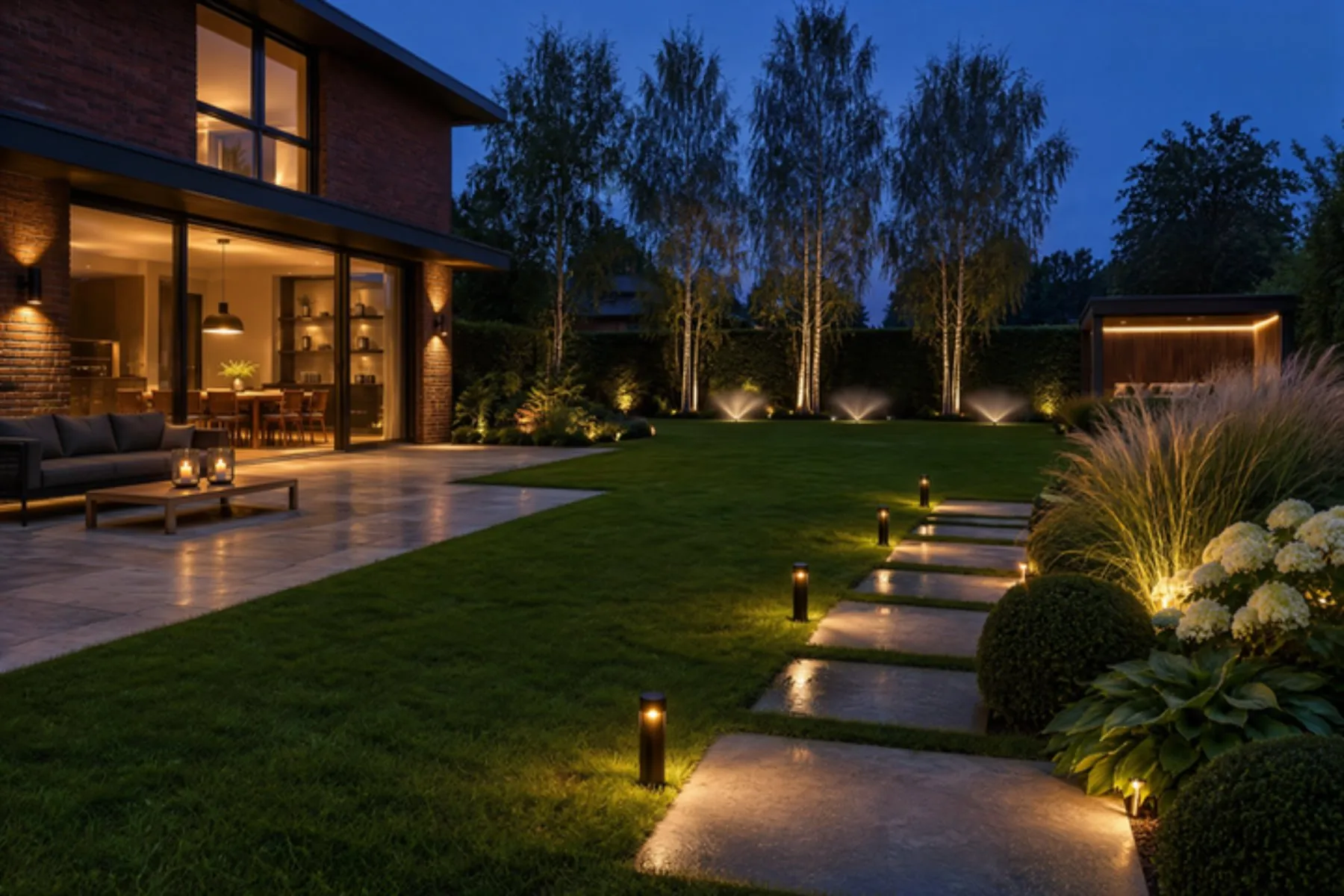
Garden at dusk with garden lighting and discreet irrigation – Holstein Pflanzen, Tangstedt
Plan now

Plan your irrigation for the coming season

Tell us about your garden, ideally with photos. We will get back to you and arrange a site visit.