
 AI · AI-generated
Block-paved paths
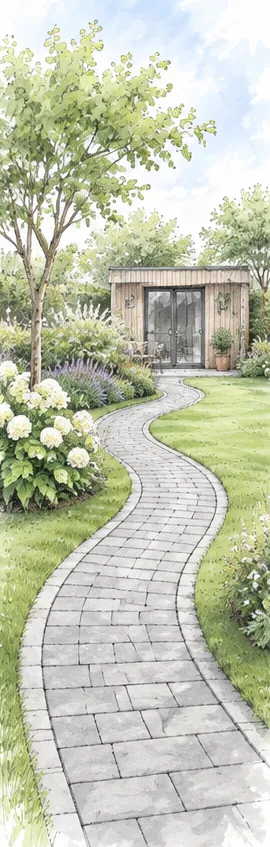
Hard-wearing, level and available in many colours and formats. Block paving can be laid straight or curved and is easy to use with a wheelbarrow, bike or rollator.
Good paths lead where you actually walk, and keep you dry, level and safe underfoot. We build garden paths in block paving, slabs, clay pavers, natural stone or gravel, plus stepping stones and garden steps with neat edging, as a landscaping firm based in Tangstedt.
Worn tracks across the lawn, muddy corners by the compost heap, a detour to the bins: where paths are missing or in the wrong place, daily life finds its own way. With as many rainy days as Hamburg and the Pinneberg district get, you soon notice how much a dry, firm path is worth.
A well-planned path links house, patio, garden shed and beds by the shortest route, and gives the garden structure at the same time. A curved path looks natural and slows your pace. A straight one looks crisp and modern.
To stay level for good, paths need what every paved surface needs: a load-bearing sub-base and solid edging. That is the only way to stop stones creeping outwards and keep gravel where it belongs.
As landscapers, we never build a path in isolation. We look at the whole picture: materials that suit the house and patio, steps where the level changes, and lighting for the evening.
Many gardens have one: the narrow brown strip straight across the lawn. It runs from the garden gate to the patio, from the kitchen door to the compost heap, or from the garage to the front door, usually exactly where no path was planned. Landscape architects call these tracks ‘desire paths’. They show more honestly than any plan how a plot is really used.
That is why we look closely at these tracks when we plan new paths. People cut the corner on a path that forces a detour. A path that follows the natural line gets used without a second thought, and protects lawn and beds at the same time. Good path layout comes from observation, not from a ruler.
In the damp climate between the Elbe and the Alster, you soon see which paths are well built. Leaves, moss and algae make shaded paths slippery in autumn, and puddles linger on loamy soil. So we plan the fall and the sub-base to shed water quickly, and choose surfaces with good grip for shady spots. In the sandy geest gardens around Pinneberg, gravel and chipping paths work particularly well, because the ground drains freely by itself.
How wide a path should be depends on who uses it and how often. These three points make a path that feels right.
 AI · AI-generated
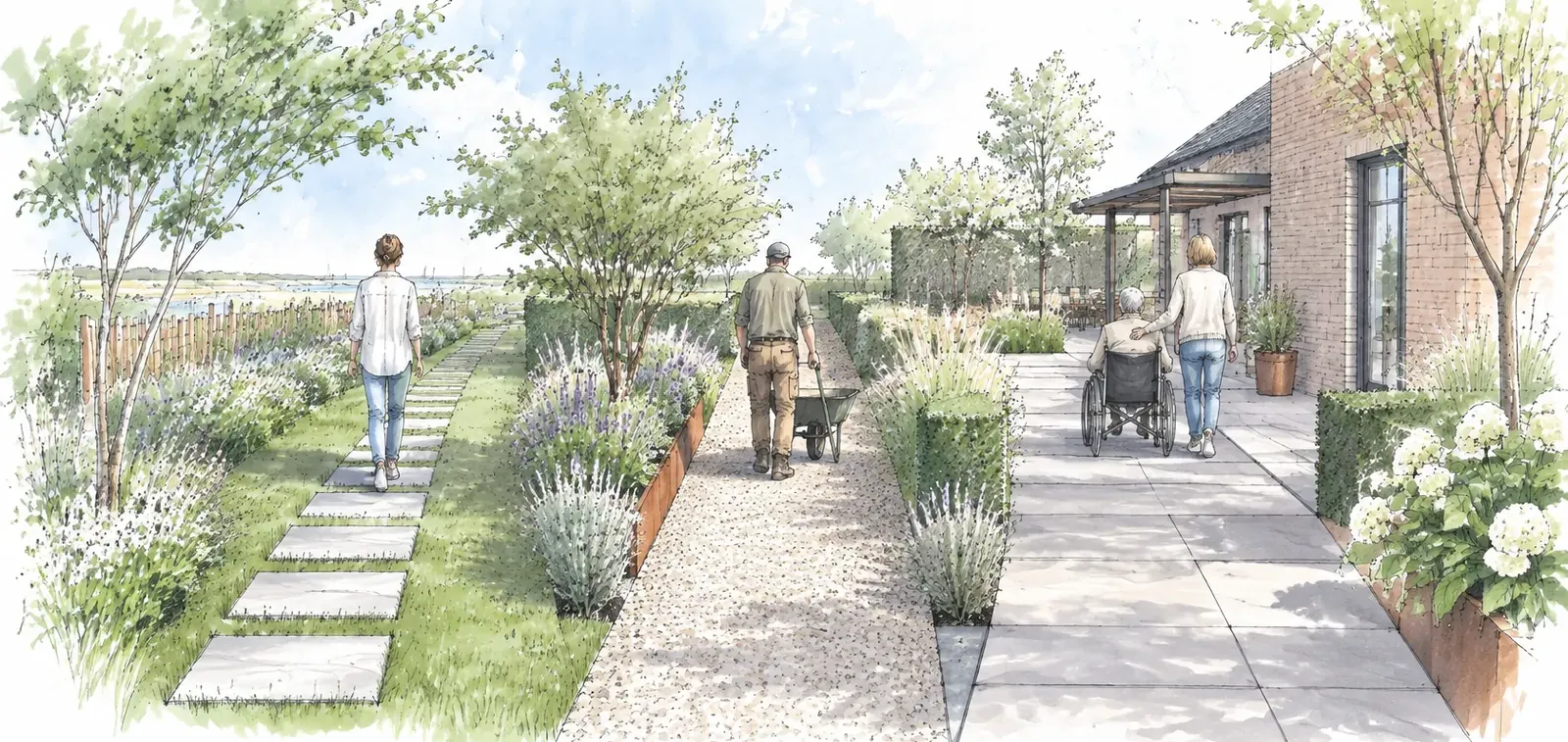
Stepping stones need only 40 to 60 cm for single steps. A secondary path of 80 cm to 1 m suits one person with a wheelbarrow. A main path of 1.20 to 1.50 m gives room for two people side by side or a wheelchair.
The path to the front door should be wide enough for two people to walk side by side. Secondary paths to the shed or compost heap can be narrower.
A compacted sub-base and a slight fall to one side let rain run off and stop the path from sinking.
Edging kerbs or metal edging keep paving and gravel in shape and give clean edges to lawn and beds. They are easy to mow along and built to last.
For garden steps we use the old stride rule: two risers plus one tread should come to roughly 63 cm, the length of a relaxed stride. Outdoors, shallower steps with a deeper tread are more comfortable than indoors, around 14 cm high and 35 cm deep. That way you climb garden steps without thinking about it, even with a watering can in your hand.
AI · AI-generatedHard-wearing, level and available in many colours and formats. Block paving can be laid straight or curved and is easy to use with a wheelbarrow, bike or rollator.
 AI · AI-generated
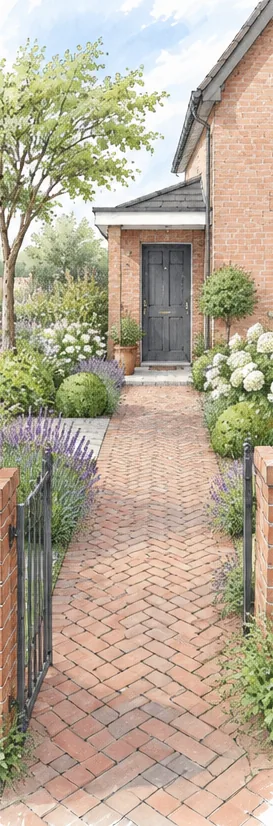
Clay pavers go particularly well with north German brick houses. They keep their colour, last a very long time and tend to look better with age. They are ideal for front paths and paths along the house wall.
 AI · AI-generated
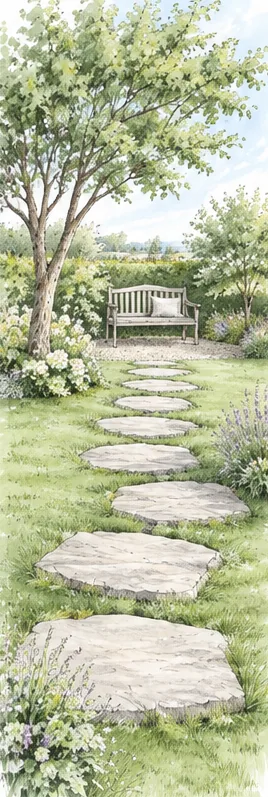
Single slabs in the lawn, in gravel or in a bed are a light, natural answer for paths you seldom use. We set them at stride spacing and flush with the ground, so you walk comfortably and the mower runs straight over them.
 AI · AI-generated
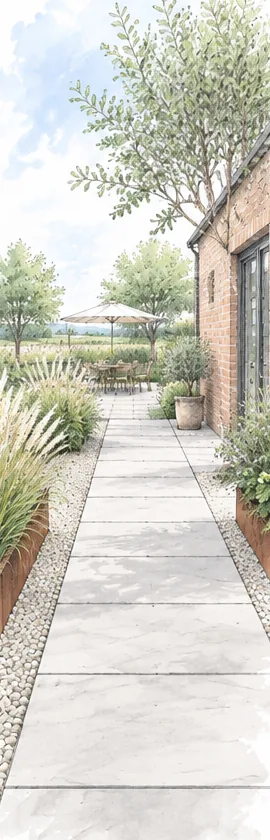
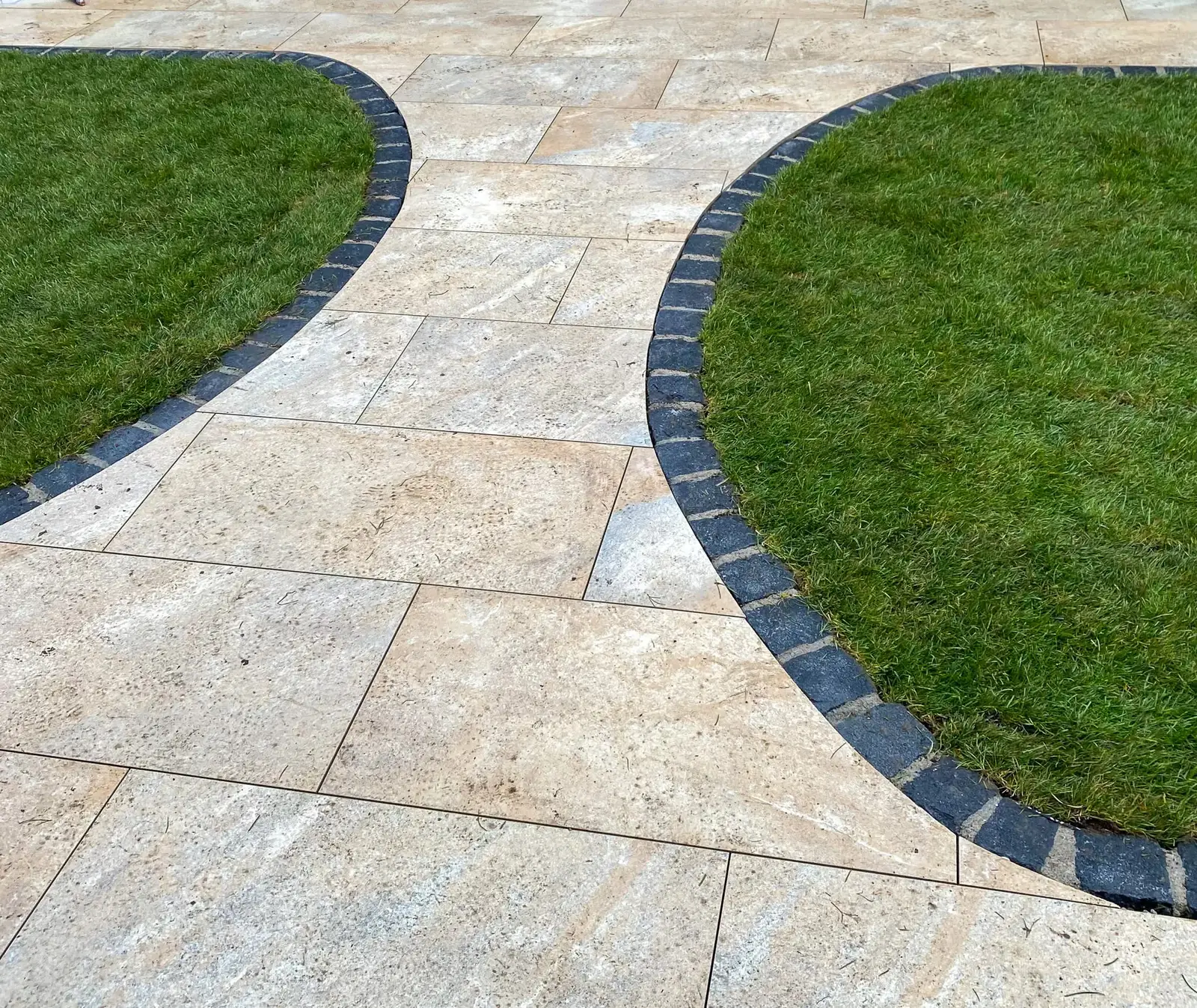
Large-format slabs in natural stone, porcelain or concrete look calm and high-quality, especially at the front door. They need a very level sub-base and the right bedding.
 AI · AI-generated
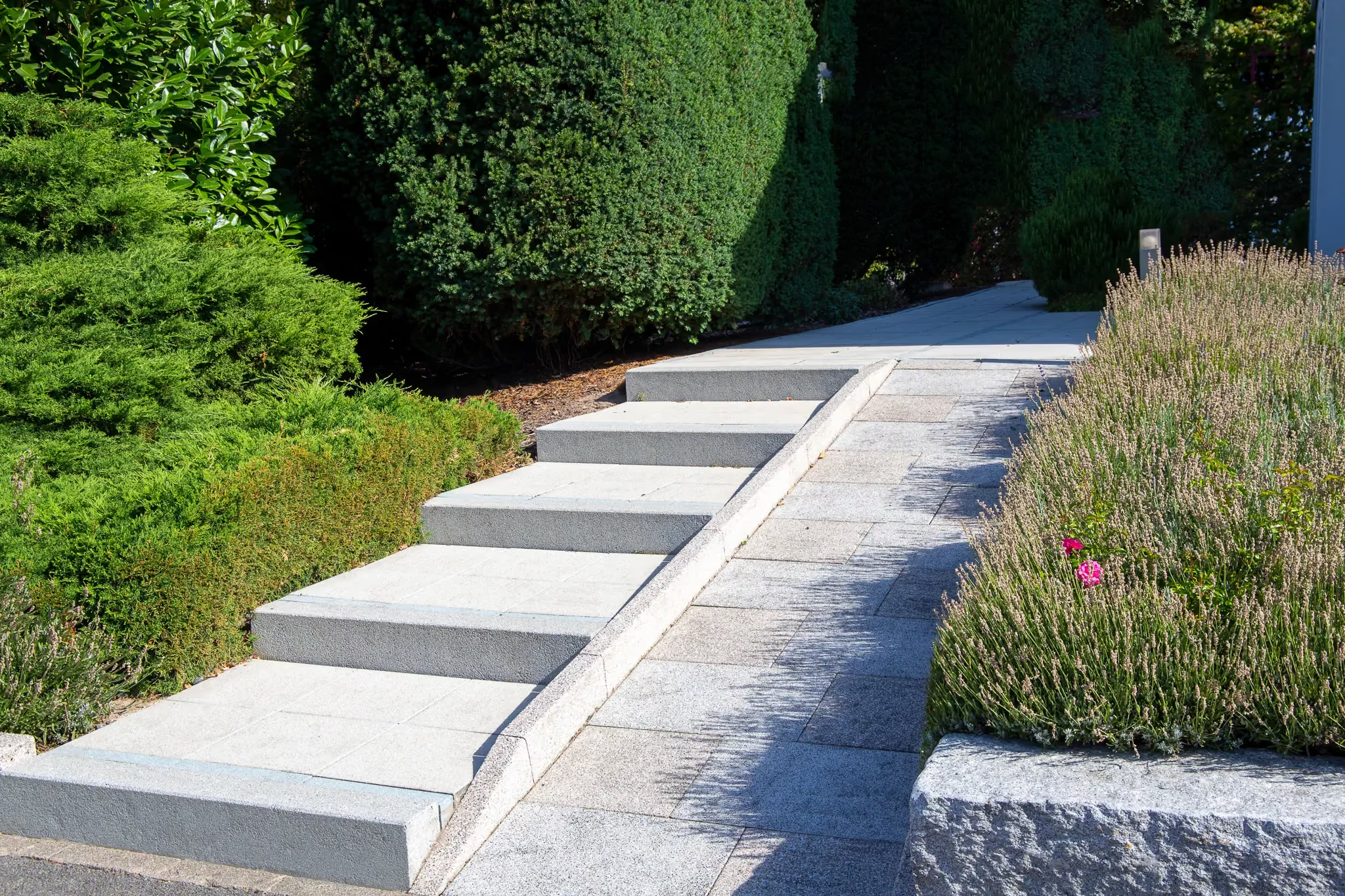
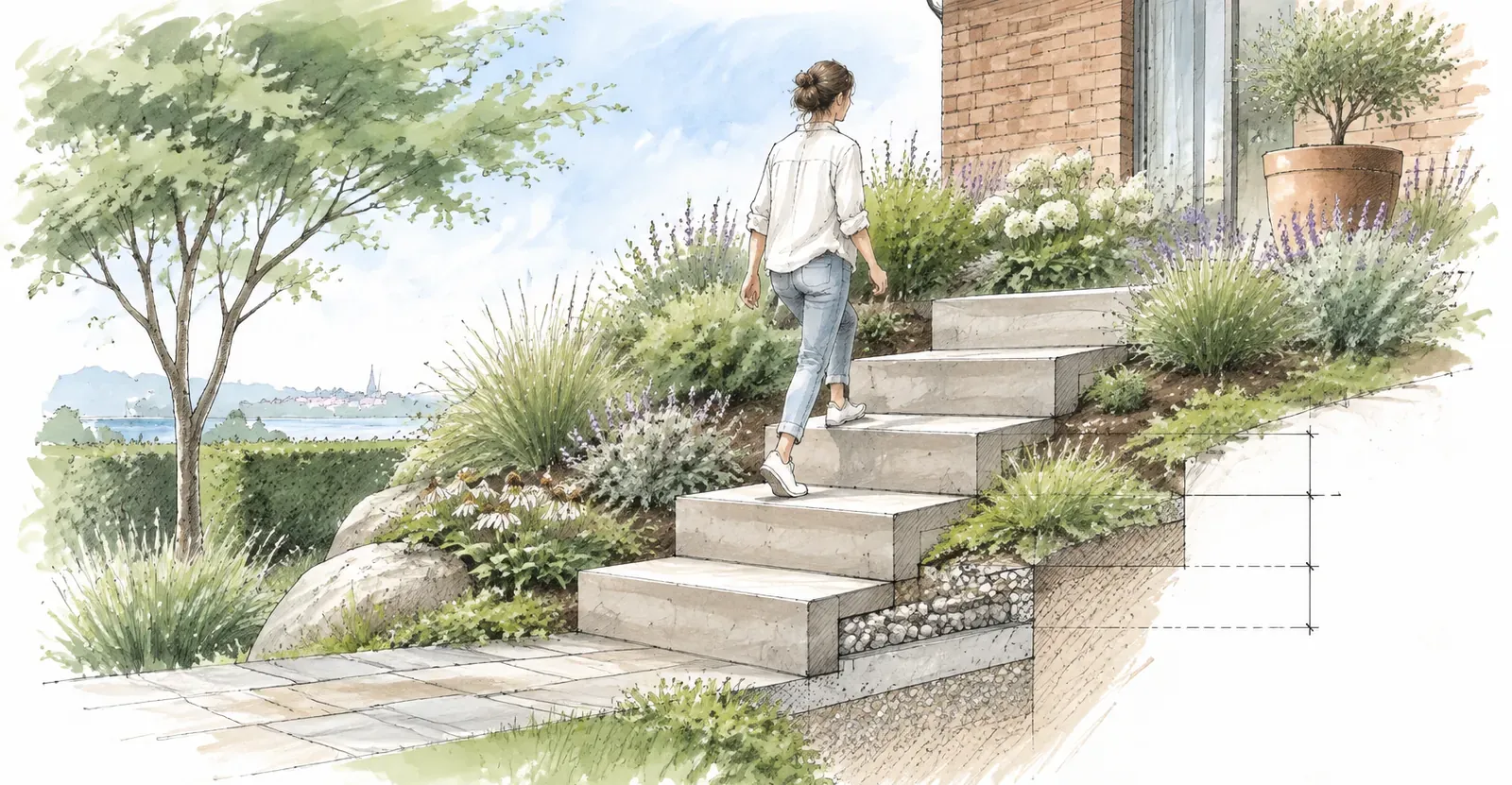
Steps are comfortable when two risers plus one tread come to about 63 to 65 cm, for example 15 cm high and 34 cm deep. All steps are the same height and sit on a frost-proof foundation of crushed stone and concrete.
Outdoor steps are most comfortable when they are shallower and deeper than stairs indoors. The stride rule has proved itself here: two risers plus one tread make one stride of roughly 63 to 65 centimetres.
Block steps in concrete or natural stone sit on a frost-proof foundation. A non-slip surface, a handrail where needed and discreet step lighting keep the steps safe in the wet and after dark.
Gravel paths are inexpensive, let water through and crunch underfoot in a way that simply sounds like a garden. Their reputation is mixed all the same, because many are built too simply. If the gravel lies straight on the soil, it sinks in, creeps into the lawn and lets weeds through. A good gravel path has a compacted sub-base, solid edging and a top layer that is not too thick. Angular chippings lock together better than rounded gravel and are easier to walk on.
For paths that also take wheelbarrows, rollators or bikes, we fit gravel stabilisation grids. These honeycomb grids hold the material in place without the path losing its character.
Important with gravel and chippings: living edges. A narrow band of perennials or ground cover along the path does more than look better than bare stones. It also keeps the soil cool and the weeds in check.
Whether people enjoy using a path or walk across the lawn after all is decided at the planning stage.
If the path curves around the short cut, a worn track soon appears beside it. We plan paths along the routes you actually walk.
What looks generous on the plan soon feels tight between overhanging plants. Main paths need room for two people.
Without an edge, gravel creeps into lawn and beds. Edging kerbs or metal edging and a gravel bedding layer keep the path tidy.
Steps that are too high or uneven in height are trip hazards. We work out riser and tread so that all steps match and feel natural to walk.
We walk the routes through your garden with you and look at the soil, levels and connections.
We suggest the route, width, surface and steps, and prepare a quote listing every item.
We mark out the path on site so you can see the route. Then we excavate and lay the sub-base.
We set the edging kerbs or edging strips, build the steps on a frost-proof foundation and lay conduits for lighting.
We lay the block paving, slabs or gravel, joint or compact it, and tie it in to lawn and beds.
We make good the edges and lawn, tidy up and give you care tips for your path.
Before we build, we look at how you really use the garden. Where do you go every day, and where only now and then? Where do the bins, bikes and garden tools live? The answers give us the route, width and surface.
If the path also needs to work for a rollator or wheelchair, we plan it wider, without steps and with a firm, level surface. You can read more on our page about accessible gardens.
A garden path is a long-term decision. So it pays to ask a few questions that look beyond today.
Bollard lights, in-ground spotlights or lights recessed into the steps make paths safe and add accents. We lay the conduits for them before the surface goes down.
The cost depends on length, width, surface and terrain. A gravel path costs less than a paved one, and steps and natural stone add to the work. The ranges below are a guide. We give you an exact price after the site visit.
 AI · AI-generated
Wobbly slabs, trip edges, moss and weeds in wide joints: many older garden paths were laid on sand alone and have sunk over the years. Then it is worth rebuilding the path from the base up, often with a better route and a more suitable width.
We lift stones and slabs that are still in good condition and relay them on a new sub-base. If you want to renew the driveway or courtyard at the same time, you will find tips on our paving page.
More about paving ⟶For a main path where two people walk side by side, about 1.20 to 1.50 metres is comfortable. Secondary paths manage with around 80 centimetres to one metre, and stepping-stone paths with the width of one slab.
That depends on width, surface, sub-base and terrain. After a free site visit you receive a quote listing every item.
Gravel is inexpensive, lets water through and looks natural, but it gives underfoot and needs more care. Block paving is firm, level and works well with wheels too. For main paths we usually recommend block paving or slabs.
In the garden, shallower steps with a deep tread are comfortable. What matters most is that all steps are the same height. We work out the right dimensions for your change in level.
A thick enough layer of gravel on a compacted sub-base and neat edging help the most. Raking regularly and clearing leaves stops humus from building up.
Yes. With enough width, a firm surface, gentle ramps instead of steps and slip-resistant surfaces, we plan paths for wheelchairs and rollators.
Yes. We build block steps, steps in natural stone or concrete and retaining walls for slopes ourselves, with lighting on request.
In Hamburg, mainly in the west and north, and in the Pinneberg district: Pinneberg, Halstenbek, Rellingen, Wedel, Quickborn, Schenefeld and Tangstedt.
Tell us where your paths should lead, ideally with photos or a sketch. We will get back to you and arrange a site visit.