Plants that suit their spot root in faster and need less work. We plan and plant perennials, hedges, shrubs and trees to match your soil, your light and your daily life. From a landscaping firm based in Tangstedt.
A plant in the wrong place struggles for years. It grows weakly, becomes prone to disease and needs more water, feed and care. Put it where soil, light and moisture meet its needs and it develops almost by itself.
That is why every planting job starts with a look at the garden. How many hours of sun does the bed get? Is the soil sandy, loamy or compacted after building work? Where does the wind whistle through, and where does water collect? And how do you want to use the garden: as a low-maintenance space, a flower garden or a screen from the neighbours?
The answers shape a planting plan that looks good in its first summer and still works in five and ten years' time, with enough space for shrubs and trees to reach their full size.
Around Pinneberg, Halstenbek and Rellingen, many gardens sit on sandy geest soil. It drains freely and warms up quickly but holds little water. Here we improve the soil with compost and choose plants that cope with dry spells. In the Elbe marshes and on loamy plots the soil is rich in nutrients but prone to waterlogging. That calls for species that tolerate wet feet, and sometimes for better drainage. On new-build plots the soil is often compacted deep down. Unless it is loosened, even tough plants root only shallowly.
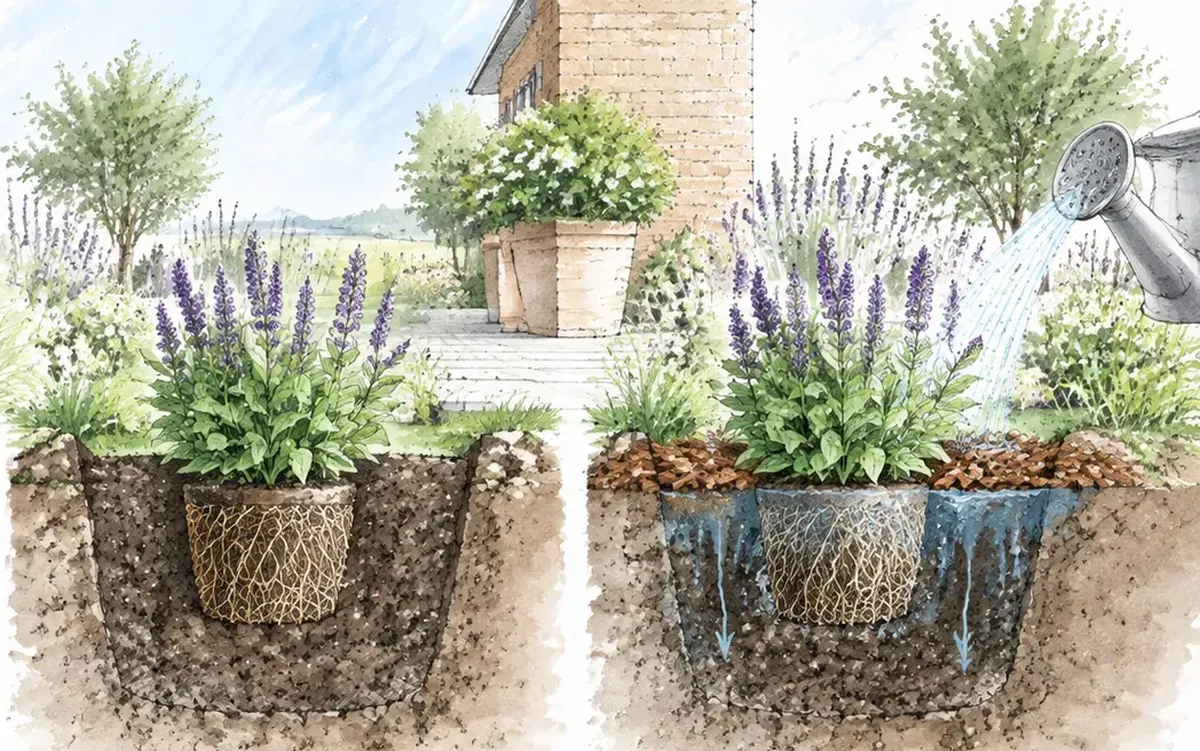
Perennial, hedging plant or tree: three steps decide whether a plant roots in quickly or struggles for years.
 AI · AI-generated
The planting hole is much larger than the root ball, and the soil in it is loosened and improved with compost. The plant sits as deep as it did in the pot, is watered in well and then mulched, which keeps the moisture in the soil.
Perennial weeds such as ground elder and couch grass are removed thoroughly, and compacted layers are loosened. Depending on the soil, we work in compost, sand or topsoil.
Plants go in at the right depth and with enough space between them. Trees are given a stake or a three-stake support so they do not rock in the wind.
Thorough watering in closes the gaps around the roots. A mulch layer of bark or compost keeps the soil moist and suppresses weeds.
Tip: Plan drip irrigation in from the start. The lines then lie under the mulch, water each plant right at the root and save a lot of watering in the first summers.
Good planting works on several levels. Trees and large shrubs give the garden structure, hedges mark its boundaries, and perennials and grasses bring colour and movement.
Flowering perennials, chosen by site and flowering time so that something is in bloom from spring into autumn. Insect-friendly and low-maintenance on request.
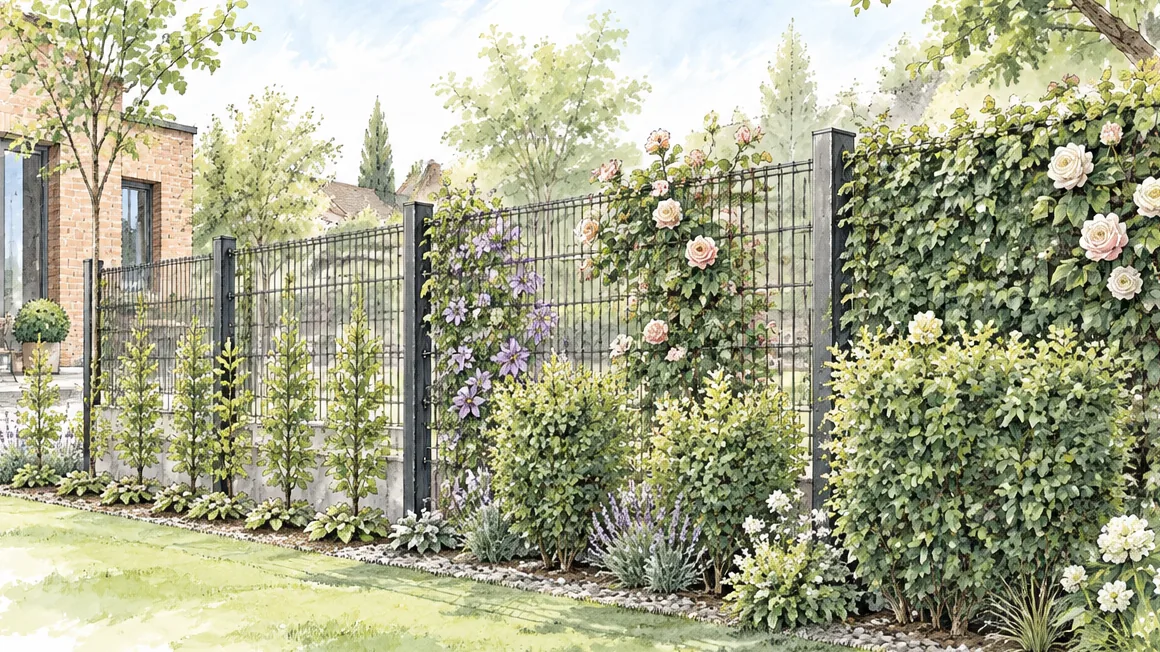
Formal hedges of hornbeam, privet or yew, informal flowering hedges or planted fences, chosen to suit the height you want, the space you have and the upkeep involved.
Garden trees, fruit trees and specimen shrubs are placed so they can grow their full crown without crowding the house, pipes and cables or the neighbours.
Spreading plants fill bare patches, hold back weeds and suit slopes, the ground beneath trees and shady corners.
 AI · AI-generated
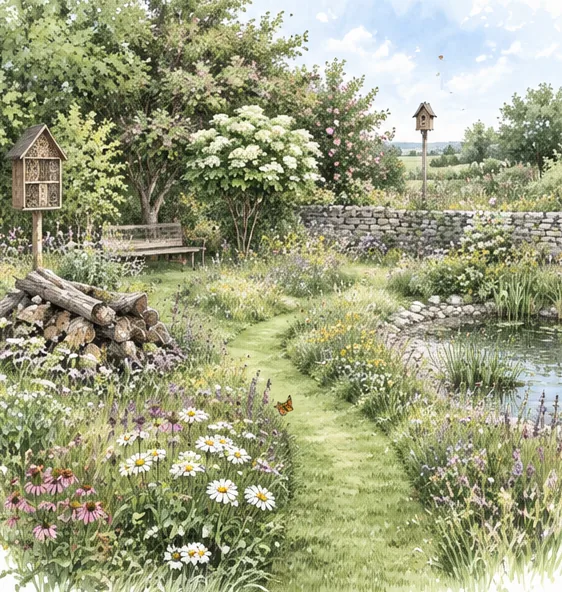
Native shrubs, flowering perennials and an area of meadow give insects and birds food and shelter. Once established, they need comparatively little care.
Which hedge suits you depends on how tall and dense it should be, how much space there is and how often you want to cut it. We advise you on site.
From October into December the soil is still warm and moist. Plants put on new roots by spring and begin the season with a head start. Bare-root hedging plants and trees are only available in the dormant season, from about October to April.
From March, once the soil has dried out, perennials, grasses and plants that are more sensitive to cold go in well. Because summer follows, they need reliable watering in the first months.
Plants in pots or containers can in principle be planted all year round, as long as the ground is not frozen and they are watered enough in hot spells. For larger plantings we still recommend autumn or spring. That saves water and improves the chance that every plant roots in well.
Good to know: If you want a finished garden in spring, start planning in late summer. That leaves time for the planting plan, the soil preparation and ordering plants of the right quality.
When beds are patchy after two years or hedges fail to thicken, the plants themselves are rarely to blame. The cause usually lies in the planning and the planting.
In its first year a densely planted bed looks nicely full. After a few years the plants crowd each other, go bare from the inside and have to be thinned out.
Sun-loving perennials barely flower in shade, and shade lovers scorch in full sun. A look at light and soil before you buy saves a lot of trouble.
If the root collar sits too deep, or the plant stands in a tight hole in compacted soil, water collects and the roots do not spread.
New plants do not yet have an extensive root system. In their first summer especially, they need regular, thorough watering rather than brief, shallow sprinklings.
We look at the soil, the light, the existing plants and what you have in mind. Free and with no obligation.
For larger areas we draw up a planting plan with species, quantities and spacing. For smaller beds we agree the selection with you directly.
Old plants and perennial weeds are removed, and the soil is loosened and improved where needed.
Our team sets the plants, stakes the trees, waters in and mulches, with drip irrigation on request.
At handover we explain how often and how much to water and what to look out for in the first year.
 AI · AI-generated
A newly planted hedge takes two to three years to thicken up. Regular watering and a light trim from the second year encourage it to branch from the base.
In their first weeks, newly set plants live mainly on the water in the root ball. Only gradually do the roots grow into the surrounding soil. So the rule is to water less often but thoroughly, so that the water reaches right down to the roots. A mulch layer cuts evaporation and keeps the soil evenly moist.
Little is cut in the first year. Perennials are cut back in spring, and hedges are shaped from the second year. In well-prepared soil, most plants need hardly any feed at first.
Important: Even plants described as drought-tolerant must be watered in their first one to two summers. They only become drought-tolerant once they are deeply rooted.
The cost depends mainly on how many plants go in, at what size, and how much soil work is needed. A perennial bed with young plants costs far less than a hedge that has to give privacy from day one, or a large garden tree.
After the site visit you receive a written quote listing each item separately: plants, soil preparation, planting and, where relevant, irrigation. That lets you compare options.
Ideally in autumn, from October to December, or in early spring. Bare-root hedging plants are only available in the dormant season and cost considerably less than pot-grown plants.
That depends on the species and the size of the plants. With medium-sized plants and regular trimming, it usually takes two to four years. If you need privacy straight away, you can choose larger plants or ready-grown hedge elements.
Yes. We also plant individual beds, front gardens or the ground beneath trees, and match the selection to what is already growing there.
Above all, a plant in the right place is low-maintenance. Robust perennials, ground cover and grasses that suit the soil and light close up the area and leave weeds little room. We put the selection together accordingly.
In dry weather, water thoroughly about two to three times a week for the first few weeks, then less often. What matters is that the water reaches the roots. Drip irrigation takes care of that for you.
Yes, and it makes sense. In a new garden we plant after the building work on the patio, paths and lawn. That way the new plants are not damaged and the lines for irrigation and lighting are already in.
Tell us about your garden, ideally with photos. We will get back to you and arrange a site visit.
