
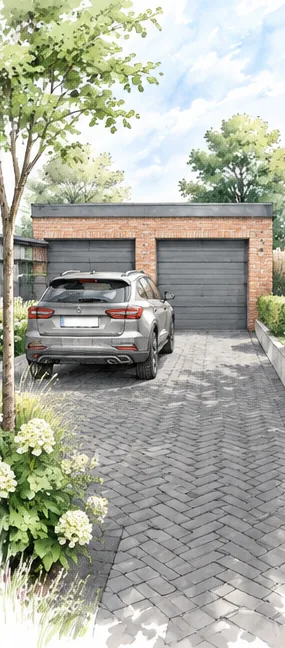
 AI · AI-generated
Concrete block paving
Versatile, dimensionally accurate and good value. Concrete blocks come in many colours, formats and finishes, from plain grey to a refined ground surface. Ideal for driveways, parking spaces and modern houses.
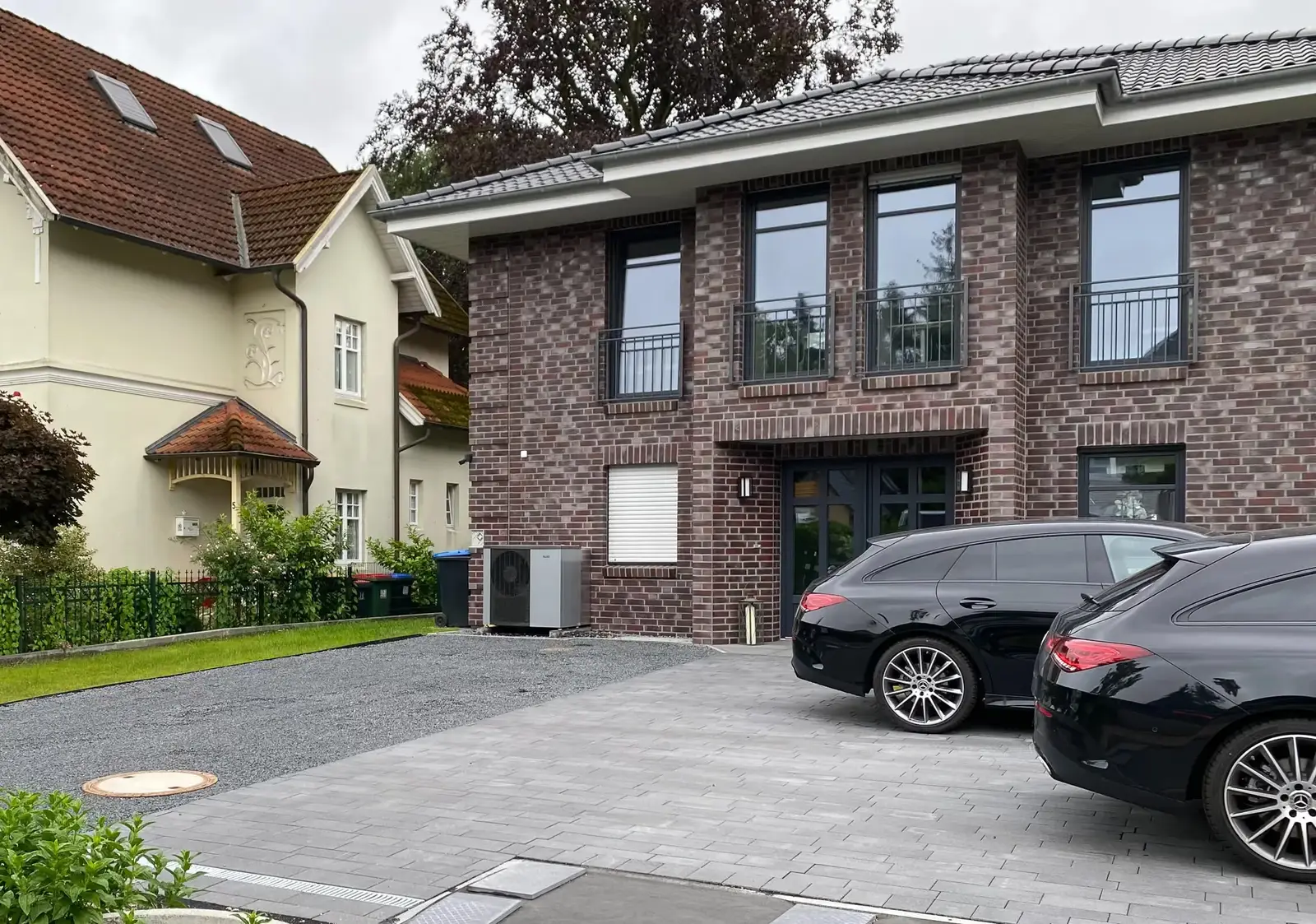
Driveways, courtyards, parking spaces and entrances take a lot of wear every day. We lay paving on a load-bearing sub-base, with a proper fall and stones that suit your house and how you use the space. Choose concrete block, clay pavers or natural stone, laid by a landscaping firm based in Tangstedt.
Ruts in the driveway, sunken stones by the carport, puddles at the front door: the cause is almost never the stone. It lies underneath. Soils in Hamburg and the Pinneberg district are often loamy, or were backfilled after the house was built. Here the sub-base decides how long the paving lasts.
That is why we excavate deep enough, lay the frost-protection layer and sub-base in layers, and compact each one. Only then do the bedding and paving go on top, with a fall that takes rainwater to a channel, a planting bed or an infiltration area.
A driveway that carries a car every day needs a different build-up from a garden path. Cut corners here and you often notice after the first winter.
As landscapers, we plan the paving together with its surroundings: neat junctions with the house, garage and lawn, steps and landings at the entrance, and room for planting beds and lighting.
A good driveway has a curious quality: you stop noticing it. You drive over it every day, wheel the bins across it, park the trailer on it, and never give it another thought. A bad driveway is quite different. After the first winter it makes itself known with ruts, rocking stones and puddles exactly where you get out of the car. The cause is almost never the paving stone. It lies underneath.
We have lifted and rebuilt many old driveways. The picture is usually the same: a sub-base that is too thin, topsoil or rubble in the ground, no edge restraint and no fall. Save money in these places and you pay twice later.
Few regions are shaped by brick as much as northern Germany. Red and multicoloured clay pavers suit the typical brick houses in Hamburg, Pinneberg and Tangstedt. They are extremely hard, keep their colour and tend to look better with age. Everyone knows large granite setts from the streets of Hamburg's old town. In gardens we like to use them as edging or as an accent. Concrete block paving is the most versatile and usually the cheapest option. It comes in many formats and colours, and in permeable versions too.
Paving is a system of several layers. These three elements decide whether the surface stays level for good.
 AI · AI-generated
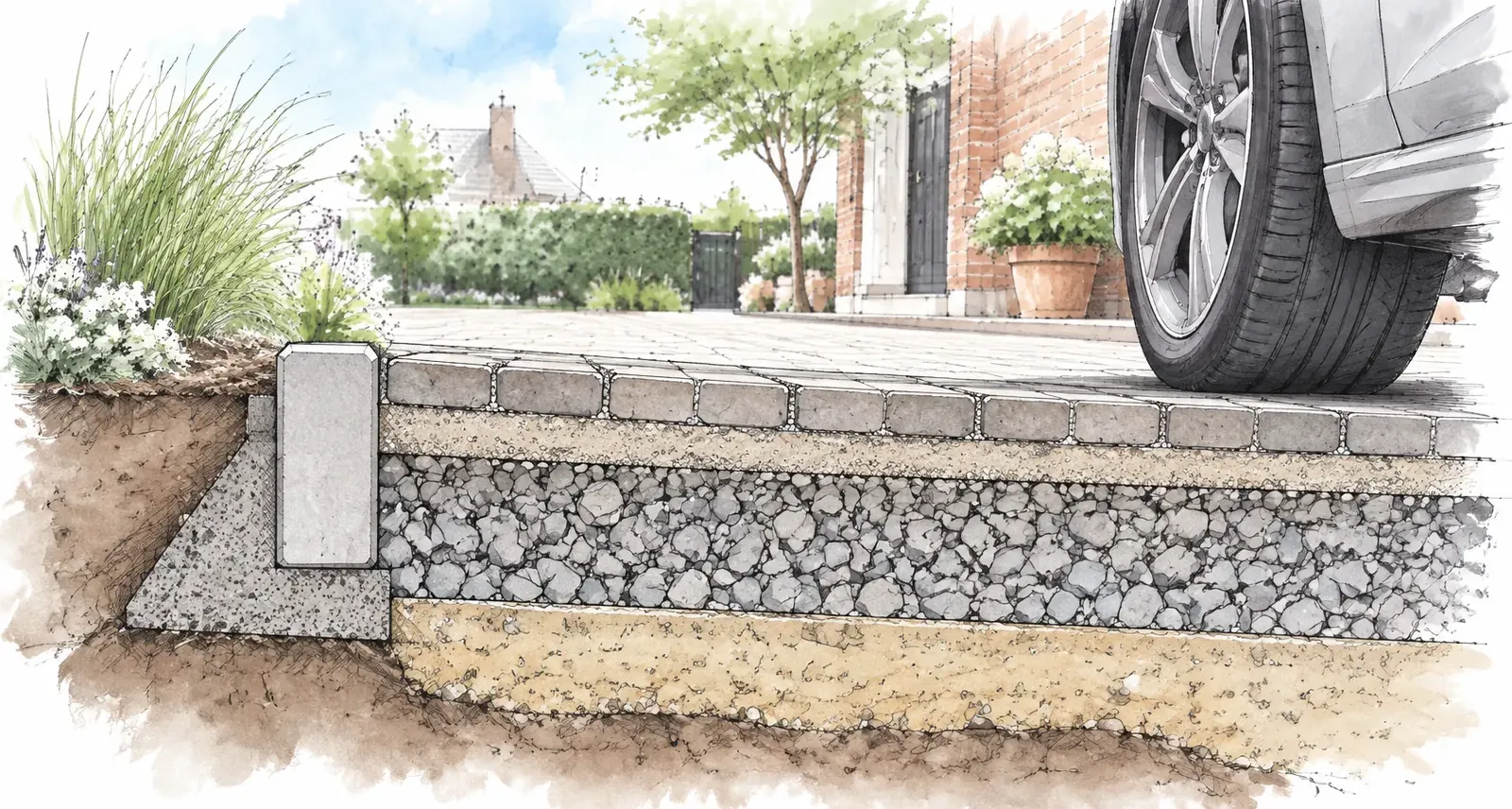
A driveway built for vehicles needs far more beneath it than a patio: paving on a bedding layer of grit, then a strong crushed-stone sub-base and a frost-protection layer. Edging kerbs set in concrete with haunching stop the surface spreading sideways.
Layers of gravel and crushed stone carry the load and let water drain away. Their thickness depends on the soil and the use: considerably more for driveways than for footpaths.
An even bedding layer of grit takes up small irregularities. The fall is built into the sub-base itself, so water runs off reliably.
The stones are laid in the chosen pattern, compacted with a plate compactor and jointed. Edging kerbs set in concrete stop the surface creeping sideways.
A surface used only by people on foot is a different job from a driveway for a heavy electric car or the occasional delivery van. The build-up is designed to match.
How thick the layers need to be in your case depends on the soil. Load-bearing sand often needs less than soft loam or made-up ground. We check this before we quote, so the figure in the quote fits the site.
AI · AI-generatedVersatile, dimensionally accurate and good value. Concrete blocks come in many colours, formats and finishes, from plain grey to a refined ground surface. Ideal for driveways, parking spaces and modern houses.
 AI · AI-generated
Granite or basalt setts are almost indestructible and look natural and full of life. They suit courtyards, driveways and paths with character, and still look good decades later.
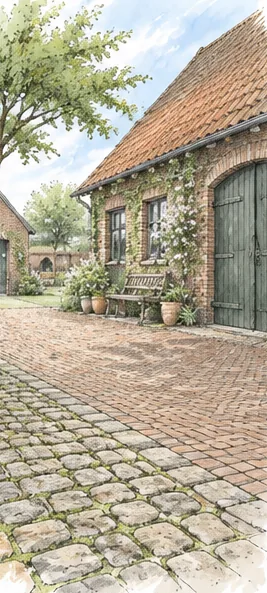 AI · AI-generated
Clay pavers and reclaimed stones go particularly well with north German brick houses. They keep their colour, are hard-wearing and give entrances and courtyards a classic character.
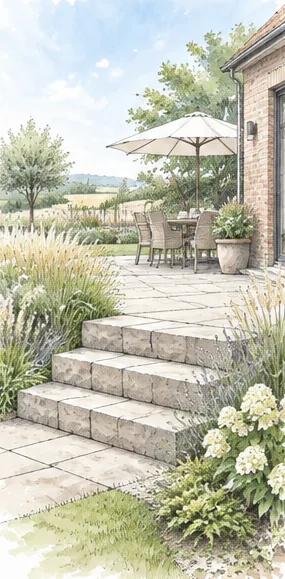 AI · AI-generated
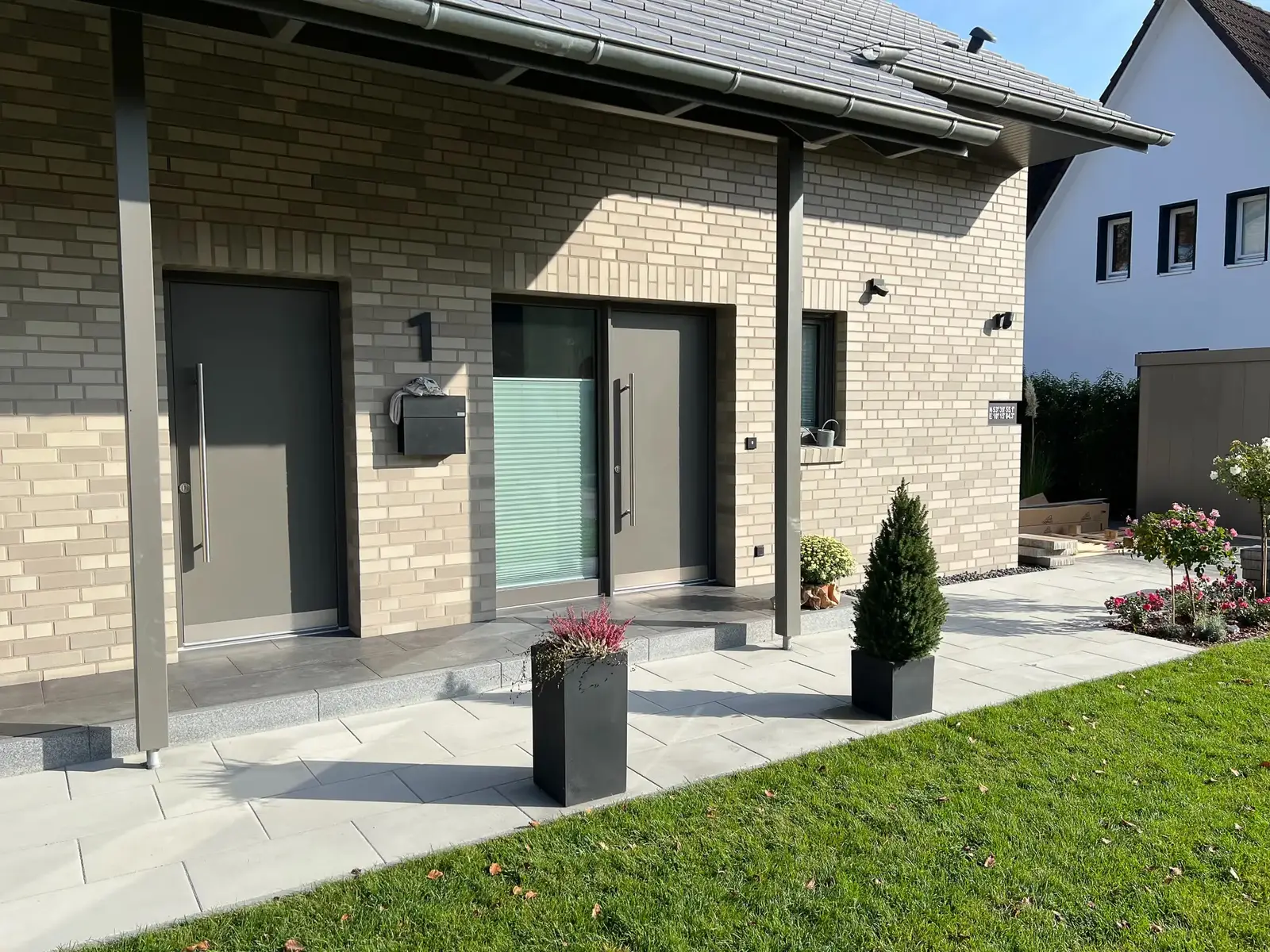
At the front door or between levels we set block steps and landings to match the paving. The result is a safe, consistent entrance, with built-in lighting on request.
 AI · AI-generated
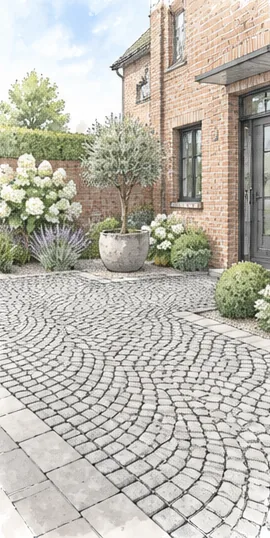
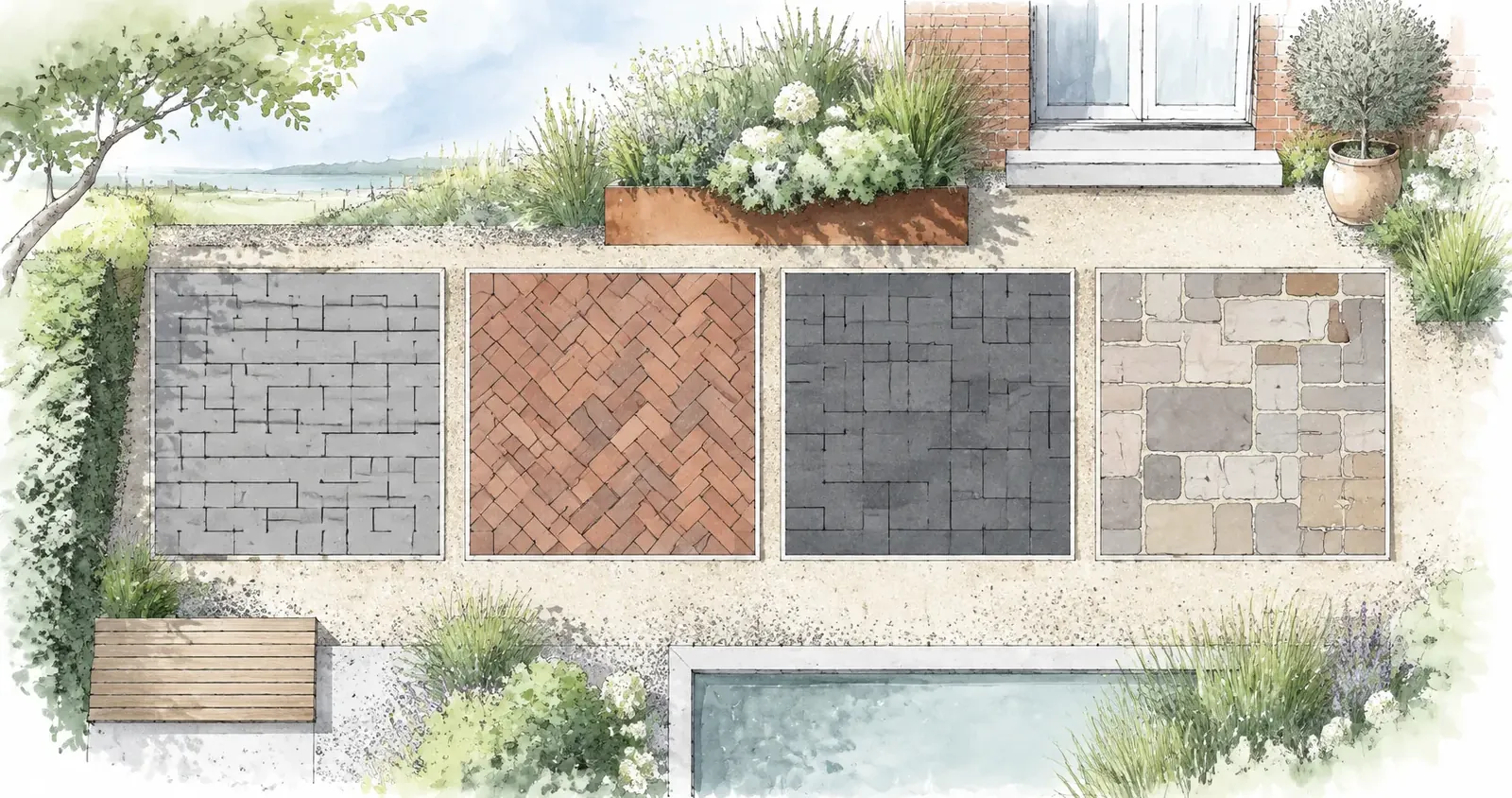
Stretcher bond looks calm and makes paths seem longer. Herringbone interlocks particularly well and is ideal for driveways. Basket weave looks orderly and modern, while random bond is livelier and typical of natural stone and clay pavers.
Stretcher bond looks calm and makes areas seem longer. Herringbone locks the stones together particularly well and suits driveways with heavy traffic. Natural stone is often laid in segmental arcs or in a random pattern.
Well-filled joints stabilise the paving and keep weeds out. Top up the sand after the first year, sweep rather than pressure-wash, and re-joint now and then. That keeps the surface in shape for a long time.
The joint holds the paving together. It spreads the load to the neighbouring stones and stops individual stones from shifting. In unbound construction it is filled with jointing sand or fine grit, which lets water through but is prone to weed growth. If you want fewer weeds, you can opt for a firm, permeable jointing mortar. It has to suit the sub-base, though, or cracks will appear.
Our advice on care: do not blast the joints with a pressure washer. That flushes out the jointing material and the surface loses its hold. A joint scraper, a stiff brush and an occasional top-up of sand work better.
Good to know: In Hamburg, the rainwater charge is based on the sealed area connected to the sewer. Permeable paving or a soakaway can reduce the charge. The exact rules are set by the utility company.
Between the Elbe and the Alster it rains often, and increasingly it rains hard. A paved surface has to carry this water away safely, without puddles forming or water running towards the house wall. That is why we plan every surface with a fall of about 2 to 2.5%. That is enough for water to run off and gentle enough that you do not feel it underfoot. We decide beforehand where the water goes: into a planting bed, a channel, a soakaway or the sewer.
Permeable paving is worth considering more and more often. Stones with wider joints, eco paving or grass-joint pavers let part of the rain soak straight into the ground. This eases the load on the sewers and, depending on the municipality, can also lower the rainwater charge because less area counts as sealed. It needs a permeable sub-base. On compacted loam without drainage it does not work.
Care depends on this planning too. Joints filled with the right material grow over more slowly. You can remove weeds with a joint scraper or hot water. Pressure washers flush out the jointing material and should be used with caution. After cleaning, top up the sand and the surface stays stable for years.
Ruts, puddles and loose stones are not a matter of age. Most of them start when the paving is built.
If a driveway is only excavated as deep as a footpath, ruts soon form under the tyres. The build-up has to match the load.
A thick layer of crushed stone cannot be compacted properly in one go. It settles later, and the paving settles with it.
Without concrete haunching the edges give way, joints open up and the surface spreads apart.
Without a well-planned fall and drainage channels, rain collects in front of the garage or front door. The result is puddles, ice in winter and damp walls.
We look at the area, soil, levels, junctions and how you plan to use it: footpath, parking space or driveway.
We show you suitable stones and patterns and prepare a quote covering the build-up, drainage and every item.
The old surface and soil are dug out and taken away, and conduits and channels are prepared.
The frost-protection layer and sub-base are laid and compacted in layers, and the edging kerbs are set in concrete.
The stones are laid in the chosen pattern, cut to fit, compacted and jointed.
We check the fall and junctions, tidy up and give you tips on looking after the joints.
Before we pave, we work out what the area has to do. How many cars park there? Where do the bins and bicycles go? And how do you reach the front door with dry feet? The answers give us the size, build-up and layout of the paths.
Rainwater matters just as much. Large sealed areas have to be drained, via channels, adjoining planting beds, a soakaway or permeable paving. Depending on the municipality, specific rules apply.
The charging point for an electric car is a classic case. If you are building a new driveway today, lay at least one conduit to the parking space. It costs little during construction. Later it means lifting freshly laid paving.
If you might want an EV charger, a house number light or ground spotlights later, have conduits laid at the same time. Otherwise the paving would have to be lifted again.
Costs depend mainly on the area, its use and the stone. A driveway built for vehicles needs more beneath it than a footpath, and natural stone costs more than concrete block. The ranges below are a guide. We give you an exact price after the site visit.
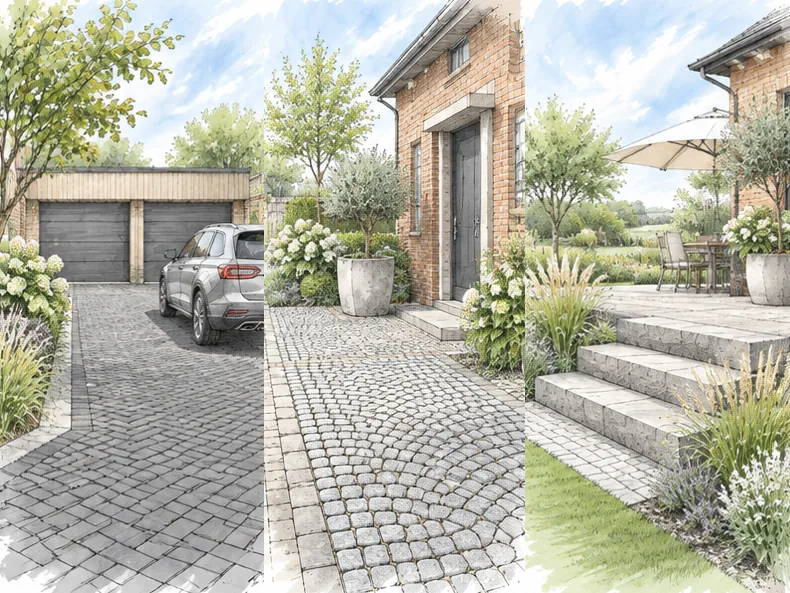 AI · AI-generated
Worn ruts, broken stones or an area where water stands: with older driveways the sub-base is often too weak. Re-jointing then only helps for a short while. The lasting fix is to rebuild from the ground up.
We can often lift stones in good condition, clean them and lay them again on a new, load-bearing sub-base. That saves material and keeps the character. If you want to renew the garden path at the same time, you will find tips on our patio page.
More on patio construction ⟶That depends on the use, stone, soil and drainage. After a free site visit you receive a quote listing every item, from excavation to jointing.
For areas that carry vehicles, concrete blocks of sufficient thickness, clay pavers or natural stone setts are all suitable. They should be laid in a bond that locks the stones together well, such as herringbone.
Depending on its size and sub-base, an average driveway is often finished in one to two weeks. We schedule the work so that you are without access for as short a time as possible.
Many municipalities require rainwater to stay on the property. Options include channels with infiltration, a soakaway, adjoining planted areas or permeable paving. We advise you on what suits your site.
Often, yes. We lift clay pavers, natural stone or concrete blocks that are in good condition and lay them again on a new sub-base.
Well-filled joints, regular sweeping and, where needed, a special jointing mortar. Chemical weedkillers are not permitted on paved surfaces.
Yes. Besides private driveways we also pave car parks, access routes and courtyards for businesses and residential complexes.
In Hamburg, mainly in the west and north, and in the Pinneberg district: Pinneberg, Halstenbek, Rellingen, Wedel, Quickborn, Schenefeld and Tangstedt.
Tell us about your site, ideally with photos and rough dimensions. We will get back to you and arrange a site visit.