
 AI · AI-generated
Boulder walls & Frisian walls
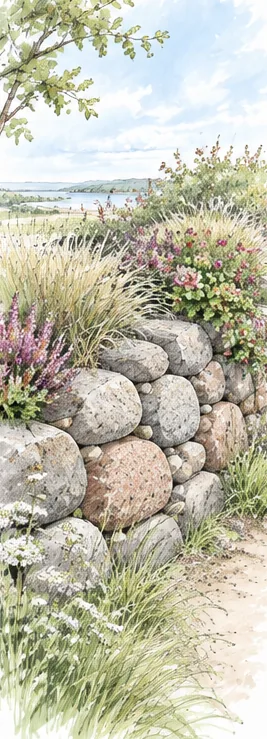
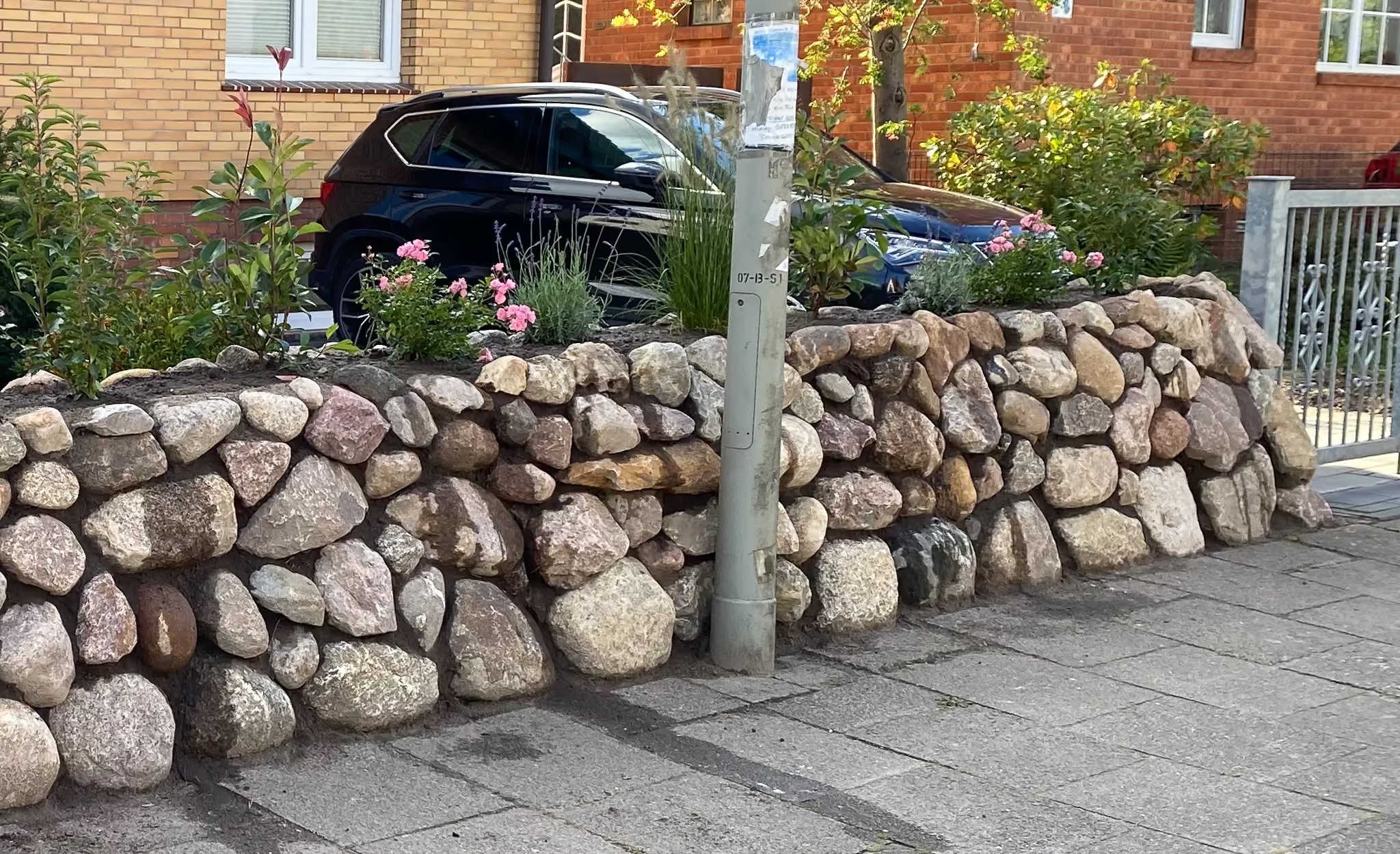
Rounded fieldstones, carefully stacked, with soil or perennials on top. The classic for front gardens and boundaries in northern Germany: robust, full of life and timeless.
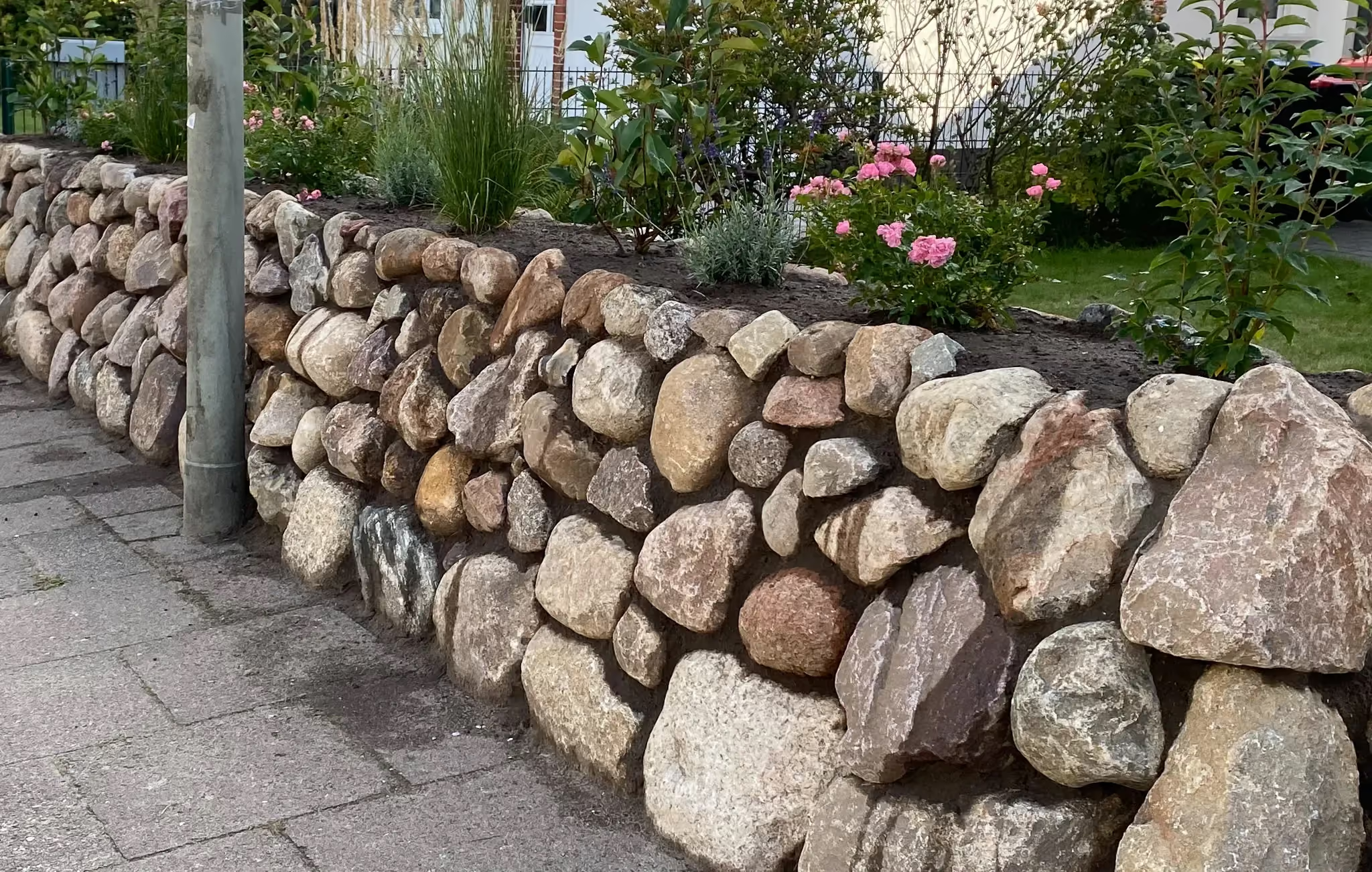
Natural stone lasts for generations, provided it is laid properly. We build boulder walls, dry stone walls and stone-faced walls, lay natural stone setts and slabs, and set stone steps. Every job gets a load-bearing foundation and proper backfill, from a landscaping firm based in Tangstedt.
Glacial boulders, fieldstones and granite setts have shaped the look of Schleswig-Holstein and Hamburg for centuries. The classic Frisian wall, a low wall of rounded fieldstones, is more than tradition. It marks boundaries, holds back changes in level and gives plants and animals a home.
Natural stone does not age, it gains a patina. Every stone is one of a kind, and its colour and texture sit naturally alongside brick houses, hedges and perennials. Built properly, a natural stone wall lasts a lifetime.
To get there, what counts is what you no longer see afterwards: a frost-proof foundation, a free-draining backfill, and stones laid in a clean bond with a slight lean into the slope.
As landscapers, we tie stonework into the whole garden: walls with planting joints and perennials, steps on sloping ground, and paths and patios in matching stone.
Drive through Schleswig-Holstein and you see them everywhere: grey and reddish boulders along field edges, at farm entrances, in old Frisian walls. Glaciers carried them here from Scandinavia many thousands of years ago, and today they lie in almost every field between the Elbe and the Baltic. Farmers gathered them over generations and stacked them into walls, without mortar, with nothing but experience and a good eye.
That tradition lives on in modern gardens. A Frisian wall along the front garden, a dry stone wall on a slope or an edging of fieldstones ties the plot to the landscape around it. Hardly any other material sits as naturally with northern German brick houses, thatched roofs and hedge banks as the stone that has always been here.
A dry stone wall is more than a boundary. Wild bees, beetles, spiders and toads shelter in its joints and cavities. The stones store heat and release it in the evening, which suits cushion-forming perennials, thyme and houseleeks. On request we plant them straight into the top of the wall and the joints. Within a few years the wall becomes a habitat that belongs to the garden.
Boulders or sandstone: a lasting wall rests on these three basics.
 AI · AI-generated
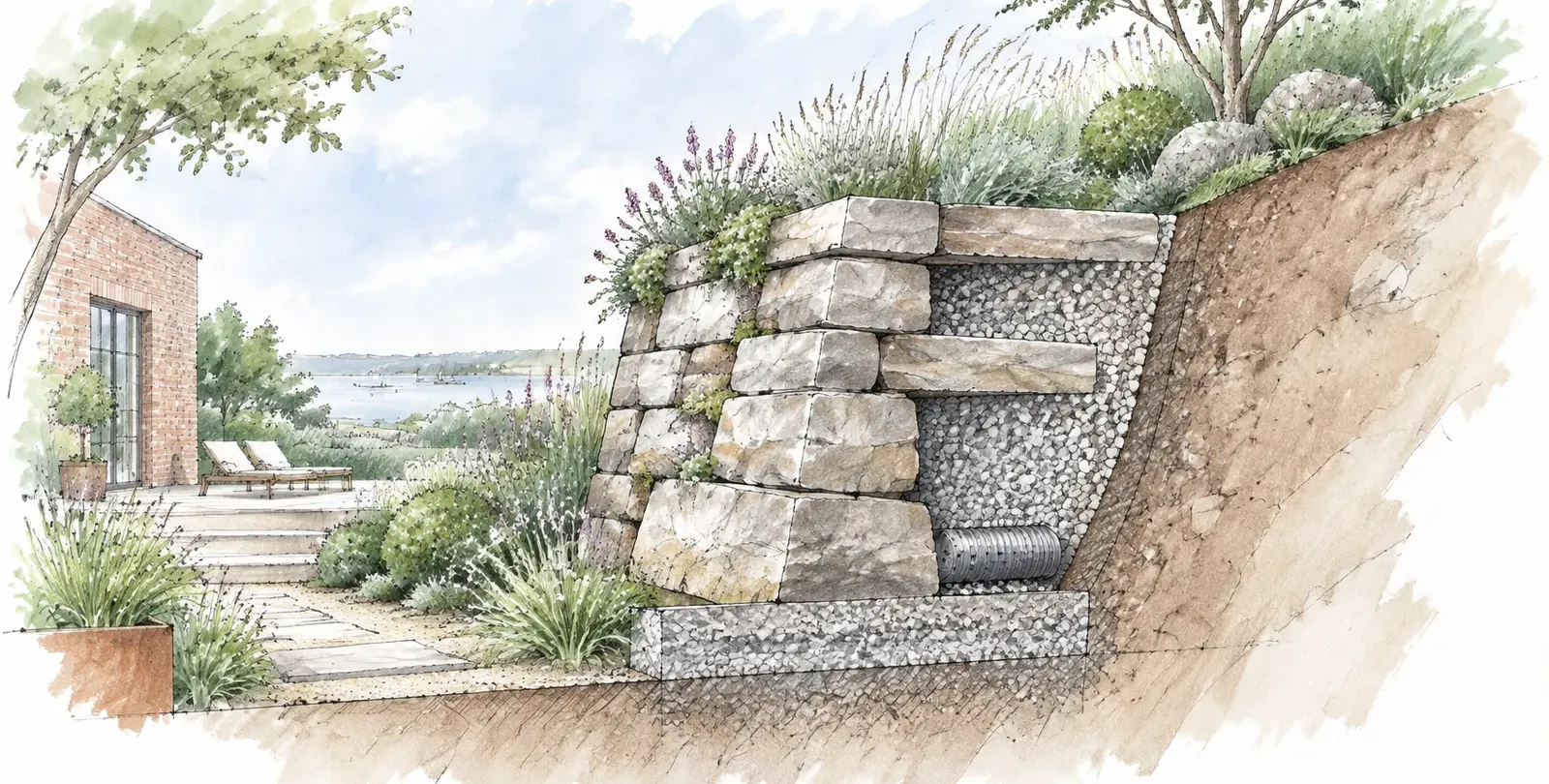
A dry stone wall holds without mortar. It stands on a compacted crushed-stone foundation, leans slightly into the slope and is anchored in the ground with long through stones. The gravel backfill with drainage takes the water pressure off the wall.
A compacted bed of crushed stone carries the wall and lets water drain away. The largest stones go at the bottom, and the first course sits slightly below ground.
The stones are laid with staggered joints, and through stones reach deep into the slope. A slight backward lean, known as the batter, braces the wall against the pressure of the soil.
Coarse gravel behind the wall stops water from building up pressure. On top, coping stones or a planted crown finish the wall.
Dry stone walls hold without any binder, purely through weight, friction and the right arrangement of the stones. That is why a few basic rules have applied for centuries, and we still follow them today.
If a wall is taller than about one metre or has to hold a steep slope, we check its structural stability and, where needed, coordinate the permit. For walls on the boundary, it pays to look at the local neighbour law early on.
AI · AI-generatedRounded fieldstones, carefully stacked, with soil or perennials on top. The classic for front gardens and boundaries in northern Germany: robust, full of life and timeless.
 AI · AI-generated
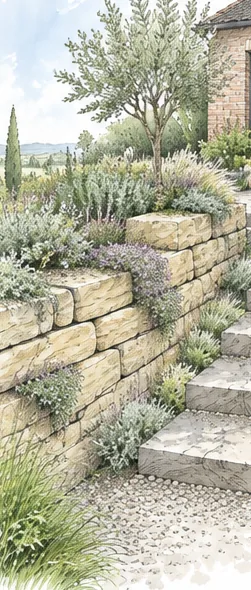
Flat, layered stones make calm, warm-toned walls, whether as bed edging, a raised bed or a retaining wall. The joints offer room for cushion-forming perennials, insects and lizards.
 AI · AI-generated
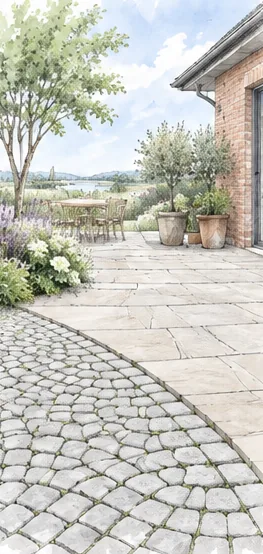
Granite setts for paths and courtyards, large slabs or crazy paving for patios. Natural stone is almost indestructible and still looks high-quality decades later.
 AI · AI-generated
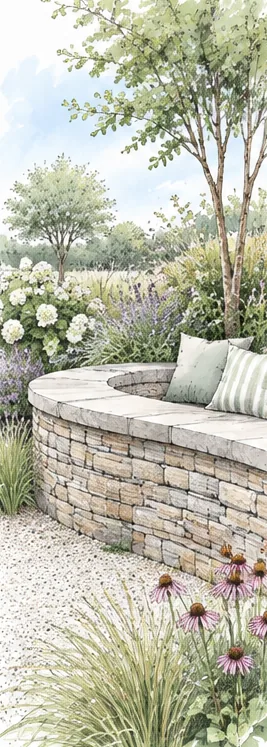
Modern walls faced in natural stone frame seating areas and take up changes in level. Add a timber top and they become a bench. Add lighting and they catch the eye in the evening.
 AI · AI-generated
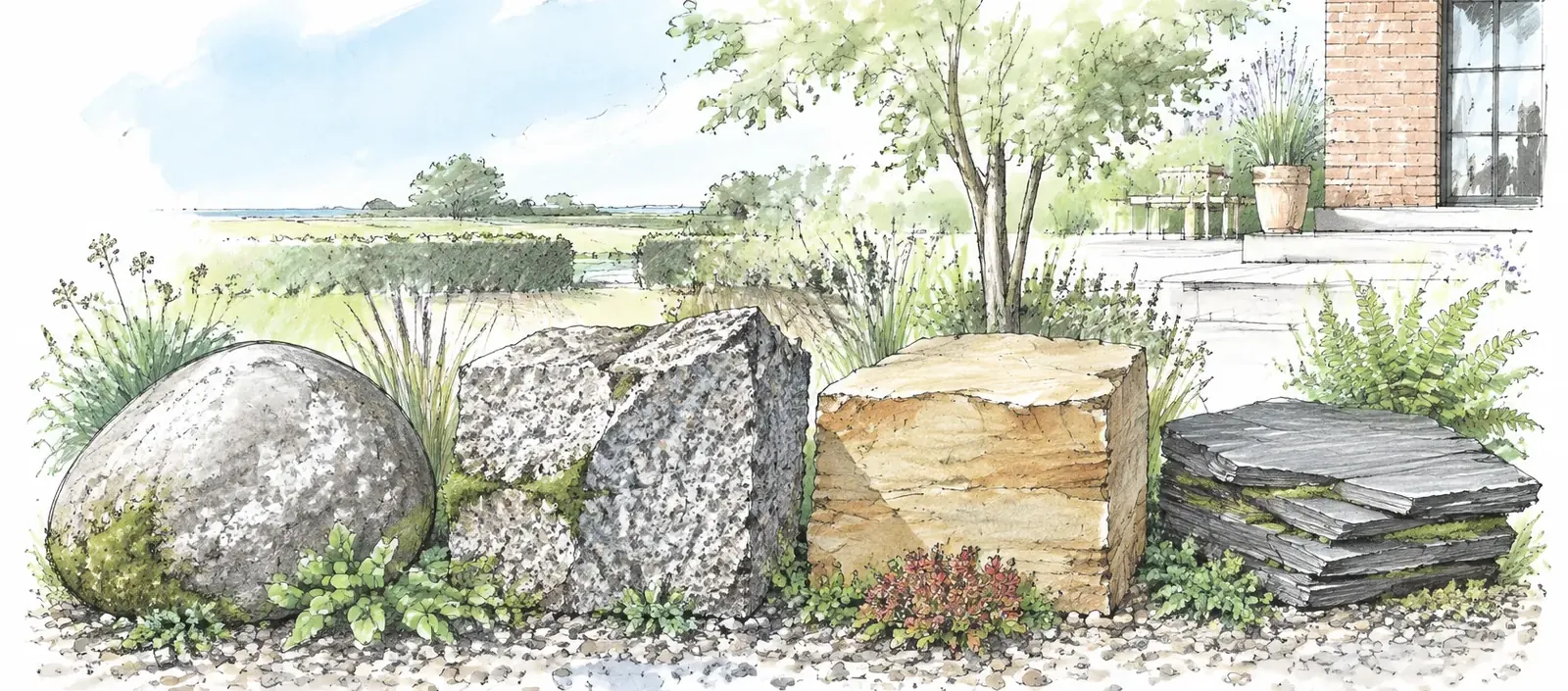
Boulders and granite are hard and frost-resistant, ideal for Frisian walls, setts and steps. Sandstone is softer and warm in colour, and slate splits into thin slabs. Which stone fits depends on use, look and budget.
Hard igneous rocks are especially resistant to frost and wear. They suit setts, steps and walls that have to take a lot, and their grey and reddish tones go well with brick.
These stones look warmer and livelier but are softer. We choose frost-resistant grades and recommend them mainly for walls, bed edging and areas that take less wear.
Boulders and fieldstones mostly come from gravel pits and fields in the region: short distances, little transport, a stone with a provenance. Granite and basalt are quarried in Europe and supplied as walling stone, setts or slabs. Quality varies widely with sandstone and slate. Outdoors they need enough frost resistance, otherwise the layers flake off after a few winters.
An often overlooked resource lies on your own plot: old walls, fieldstones from the excavation or slabs from a demolished patio can often be reused. That saves money, conserves resources and gives the new garden a history.
When walls lean, bulge or lose individual stones, the cause is almost always a mistake made during construction.
Stones set straight onto topsoil sink, and the wall ends up crooked. A compacted bed of crushed stone is the basis of every wall.
Without a free-draining backfill, wet soil that freezes in winter pushes the wall outwards.
A retaining wall with no lean into the slope stands up less well to the pressure of the soil. Even a slight batter makes a big difference.
Joints that line up one above the other create weak points. Stones laid in a bond and deep-reaching through stones hold the wall together.
We look at the site, levels, soil and surroundings and talk through the purpose, height and style of the wall.
We show you suitable types of stone and prepare a quote covering foundation, materials and planting.
We dig the foundation trench, then lay and compact crushed stone. Mortared walls get a concrete foundation.
Course by course, we lay the stones in a bond and backfill behind them with gravel.
The wall gets coping stones or a planted crown. On request we plant cushion-forming perennials in the joints.
We tie in paths, lawn and beds, clear up and give you care tips.
Is the wall only there to mark a boundary and shape the garden, or does it have to hold back a slope? That decides the construction method, the foundation and the size of stone. For taller retaining walls we check whether a structural calculation is needed.
On the boundary, rules on height and distance apply, and they differ from one municipality to the next. We point them out and plan the wall so that it suits the house, the street and your neighbours.
Natural stone forgives a lot and asks for little. A dry stone wall needs no pointing or painting. Over the years it gains patina, moss and lichen, which for many people is exactly the appeal. Check the top of the wall and the drainage now and then: if water builds up behind the wall after heavy rain, the outlet is usually blocked.
Natural stone walls need hardly any care. Clear leaves now and then, pull tree and shrub seedlings out of the joints and reset loose stones early. That is usually all it takes.
The cost depends mainly on length, height, type of stone and access. Large boulders call for machinery, and taller retaining walls need a stronger foundation. The ranges below are a guide. We give you an exact price after the site visit.
A bulge in the wall, stones that have fallen out or a lean towards the street: older natural stone walls often lack an adequate foundation or any backfill. Usually the only fix is to take the wall down section by section and rebuild it.
We generally reuse the existing stones, so the character is preserved. If you also want to renew natural stone paths and steps, you will find tips on our garden paths page.
More on garden paths ⟶That depends on height, type of stone, construction and access. After a free site visit you receive a quote listing every item.
A Frisian wall is a traditional northern German wall of rounded fieldstones, often with soil and plants on top. It marks a boundary and is robust, full of life and very long-lasting.
Low and medium-height dry stone walls are no problem. For taller retaining walls we check the construction and structural stability and, where appropriate, recommend a mortared wall or terracing.
That depends on height, position and municipality, especially on the boundary. We recommend checking with the local building authority beforehand and will support you with the details they need.
Granite, basalt and boulders are very frost-resistant. With sandstone and limestone it comes down to quality. We only use grades suitable for outdoor use.
Yes. We are happy to reuse stones from old walls or from your plot. That saves material and keeps the character.
Yes. Cushion-forming perennials, grasses and herbs that tolerate dry conditions do well in the joints of dry stone walls and on top of the wall.
In Hamburg, mainly in the west and north, and in the Pinneberg district: Pinneberg, Halstenbek, Rellingen, Wedel, Quickborn, Schenefeld and Tangstedt.
Tell us about your project, ideally with photos and rough measurements. We will get back to you and arrange a site visit.