Garden design, patios, paving, turf, fencing and automatic irrigation for Halstenbek, Krupunder, Rellingen-Ort and Egenbüttel, from a landscaping firm based in neighbouring Tangstedt.
Tangstedt, where our firm is based, lies directly north of Rellingen, and Halstenbek adjoins Rellingen to the south. So for gardens in both communities we are not a firm from “somewhere in the district” but a neighbour who is on site within a few kilometres.
Holstein Pflanzen GmbH has been designing and building gardens, patios, paths and irrigation systems since 2010, with our own permanently employed team. The work in Halstenbek and Rellingen differs from the rest of the Pinneberg district. Densely built estate and terraced-house gardens sit next to large, mature plots. Sandy geest soils, the light upland soils of northern Germany, lie next to damp hollows along streams and meadows. And the local garden culture has been shaped by more than a hundred years of tree nurseries.
This page explains what matters for a garden project in Halstenbek, Krupunder, Rellingen-Ort or Egenbüttel. For an overview of the whole district, see our page on landscaping in Pinneberg.
In short: Gardeners and landscapers for Halstenbek and Rellingen, based in the neighbouring village of Tangstedt. Garden design, patios, paving, turf, fencing and automatic irrigation. Our own team, a free site visit and a written quote.
Halstenbek and Rellingen lie in the heart of Pinneberg’s tree nursery country (Baumschulland). When Hamburg was rebuilt after the Great Fire of 1842, the city needed large numbers of trees for streets, parks and gardens. Farms in the surrounding area increasingly switched to tree nurseries. In 1883 Halstenbek gained a railway connection with its own goods station, where plants were loaded for dispatch. One part of the village is still called “Baumschulen” (tree nurseries) today.
Tree nurseries remain part of the townscape in Rellingen too, and the municipal coat of arms recalls its days as a growing area for roses and standard trees. The local landmark is Rellingen Church (Rellinger Kirche), an octagonal late Baroque building put up by master builder Cay Dose between 1754 and 1756. Around the old village centre you find established plots with mature trees, hedges and natural stone features. These are gardens where a redesign should work carefully with what is already there.
For you as a garden owner this history has a practical benefit: many shrubs and trees are grown in the region and are used to the climate and soil. We like to draw on that when choosing plants.
Halstenbek lies in a former heath and moorland landscape that was cultivated over generations. Field names such as Galgenmoor or Voßmoor in Rellingen are a reminder of this. Most gardens today stand on sandy geest soil, which drains quickly and holds few nutrients. In lower-lying spots and close to watercourses, however, the ground can be humus-rich, peaty or damp.
The Ballerbek and Burbek streams flow through Halstenbek, the Düpenau forms the western boundary of the municipality, and there is a protected landscape area at the Krupunder See lake. The Mühlenau, known here as the Rellau, flows through Rellingen and joins the river Pinnau. If you are building near these low-lying areas, take a closer look at the soil make-up and water conditions before you plan.
 AI · AI-generated
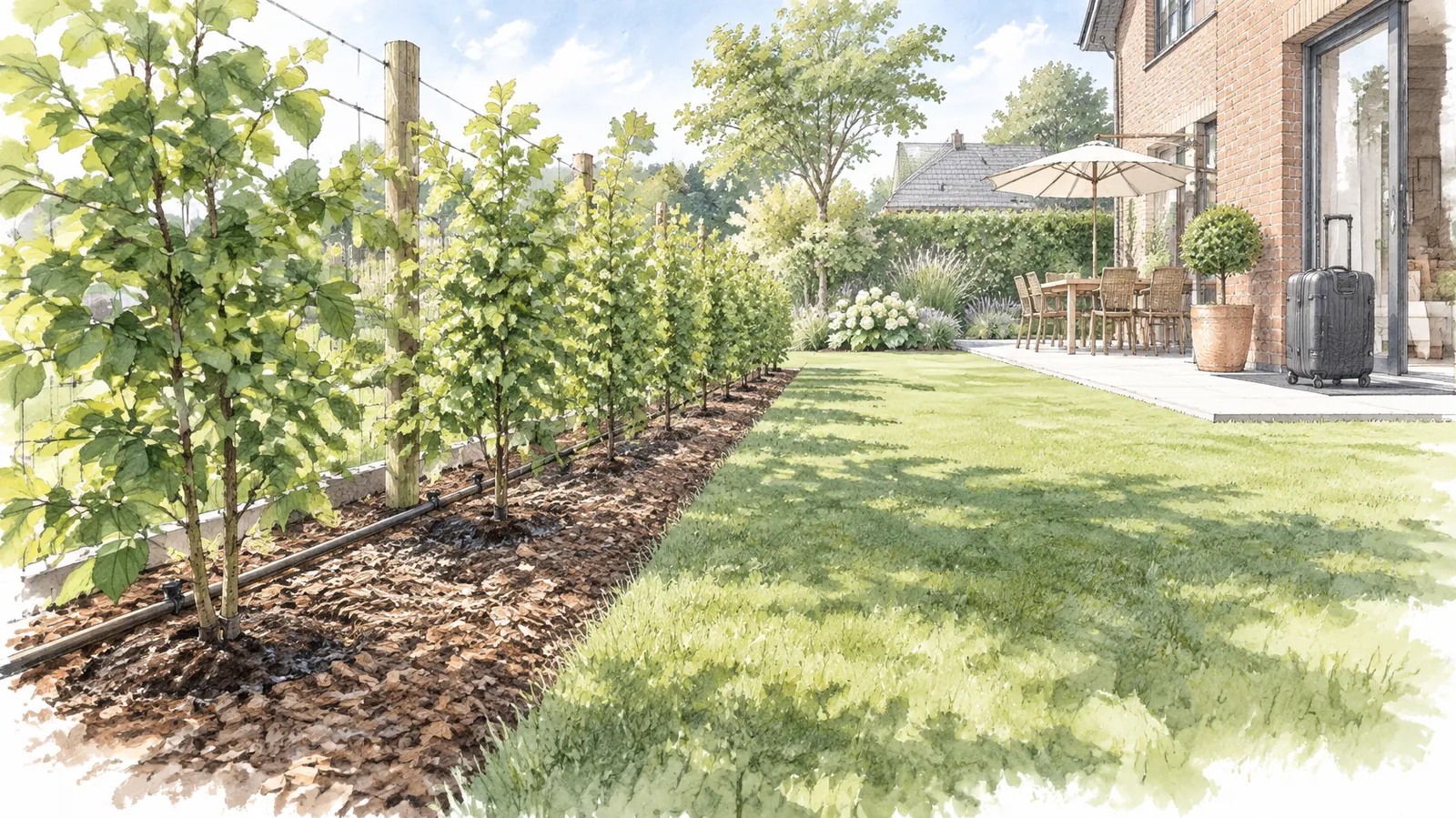
Halstenbek and Rellingen lie in the middle of tree nursery country, so strong hedge plants are available right on the doorstep. We plant them at even spacing, depending on the species, in loosened soil with compost. Autumn is the best time to plant. A drip line under mulch helps the hedge to root in well over the first few years, even when you are away in summer.
Halstenbek borders the Hamburg districts of Eidelstedt and Lurup to the east, and Rellingen also shares a short stretch of boundary with Hamburg. The plots are just as varied.
Narrow, deep gardens with little space and neighbours on both sides. Good zoning, privacy screening and low-maintenance surfaces matter here. If the garden can only be reached through the house, we plan small machinery and transport to suit. A well thought-out garden design fits a patio, a bed and a lawn into a few square metres without the garden feeling cluttered.
Larger plots from the 1950s to the 1970s, often with tall trees, old hedges and tired exposed-aggregate concrete slabs. Typical jobs are new patios and paths, renewing lawns with roll-out turf and replacing old fences with modern fencing. Where a house shows damp in the basement, external basement waterproofing can be combined with the garden redesign.
Many owners have lived in their own home for decades and want to keep using the garden. Step-free paths, raised beds and well-lit access routes make that possible. Find out more on our page on accessible gardens.
Where there are large trees, the question often comes up of what may be felled or cut back. The municipality of Rellingen has a tree protection ordinance (Baumschutzsatzung), which was revised in 2021. It mainly protects trees that are listed in the municipal tree register (Baumkataster) or that a local development plan (Bebauungsplan) requires to be kept. For trees in this register the municipality has also published a funding guideline for professional tree care. To find out whether a particular tree is affected and which rules currently apply, please ask the municipality of Rellingen directly.
The same approach applies in Halstenbek: before a larger tree is felled or heavily cut back, ask the municipality of Halstenbek whether local bylaws or requirements in the local development plan apply. Apart from this, heavy pruning and felling are generally restricted under the Federal Nature Conservation Act (Bundesnaturschutzgesetz) during the nesting season from 1 March to 30 September.
For fences, hedges and privacy screens on the plot boundary, neighbour law (Nachbarrecht) in Schleswig-Holstein and, where relevant, local development plans play a part. We raise these points at the site visit. Binding information comes from your municipality’s building authority.
We carry out all trades with our own staff. Each service has its own page with the process, materials and guide figures:
If you would like to control irrigation, garden lighting or gates by app, you will find suitable options on our Smart Garden page. Conduits for this are best laid while the patio or paths are being built.
We work in every district of both municipalities. The jobs differ depending on the location:
| District | Typical garden | What we look out for |
|---|---|---|
| Halstenbek-Ort and Halstenbek-Dorf | Detached and terraced-house gardens, some with mature trees | Access and material deliveries in residential streets, root zones |
| Krupunder (Halstenbek and Rellingen) | Estate gardens, close to the Krupunder See | Subsoil and water conditions in lower-lying spots |
| Rellingen-Ort | Established plots around the old village centre | Keeping what is there, checking the municipal tree register |
| Egenbüttel and Neu-Egenbüttel | Detached-house gardens on sandy soil | Soil improvement, irrigation, lawn build-up |
| Hamburg-Eidelstedt and Schnelsen | Gardens on the edge of the city, just across the state border | Taking Hamburg’s rules on trees and building into account |
Our yard at Pinneberger Weg 11 in Tangstedt lies north of Rellingen, and Halstenbek is only a few kilometres further south. You notice this in the project: site visits can be arranged at short notice, materials and machinery reach the site quickly, and we are still on hand for questions after handover, for example for the winterisation and spring start-up of your irrigation system.
From the first appointment to final sign-off you deal with the same contacts from our permanently employed team.
Winter is the best time to plan, so that the work can be scheduled well for spring. Paving and patio work is possible almost all year round in frost-free weather. We prefer to lay turf in spring and autumn.
Yes. We work in Halstenbek including Krupunder, in Rellingen-Ort, Egenbüttel and the other districts, and in neighbouring north-west Hamburg, for example in Eidelstedt and Schnelsen.
Our firm is based in Tangstedt, which borders Rellingen directly. Halstenbek lies south of Rellingen and is also only a few kilometres away.
That depends on the tree. The municipality of Rellingen has a tree protection ordinance that protects, in particular, trees listed in the municipal tree register. Before felling, please ask the municipality whether your tree is affected. The same goes for Halstenbek: check with the municipality first.
On sandy geest soil, lawns and beds dry out quickly in summer. Automatic irrigation with drip line and a rain sensor delivers water where it is needed and saves time. Find out more on our page on garden irrigation.
Yes. We plan small machinery and material transport so that we can reach gardens that are only accessible through the house or along a narrow path. We sort this out at the site visit.
The site visit is free and without obligation. Afterwards you receive a written quote.
No. We have worked with our own permanently employed team since 2010, and you have fixed contacts for your project.
In damp spots, a fall, a suitable sub-base and controlled infiltration help, for example via a soakaway. Whether that is possible depends on the soil and groundwater. We check this on site.
Your garden in Halstenbek or Rellingen? Call us on +49 4101 81 23 692 or send us your enquiry with photos. We usually reply within two working days and are happy to come out for a free site visit.
