
 AI · AI-generated
Paths & ramps
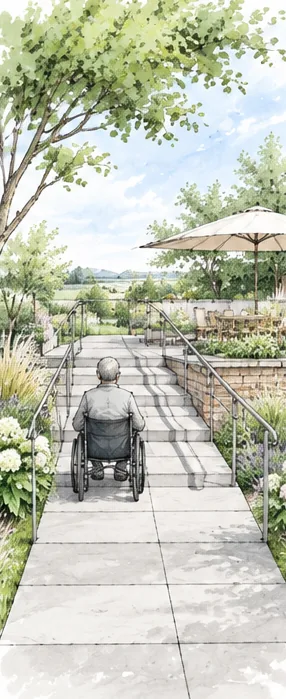
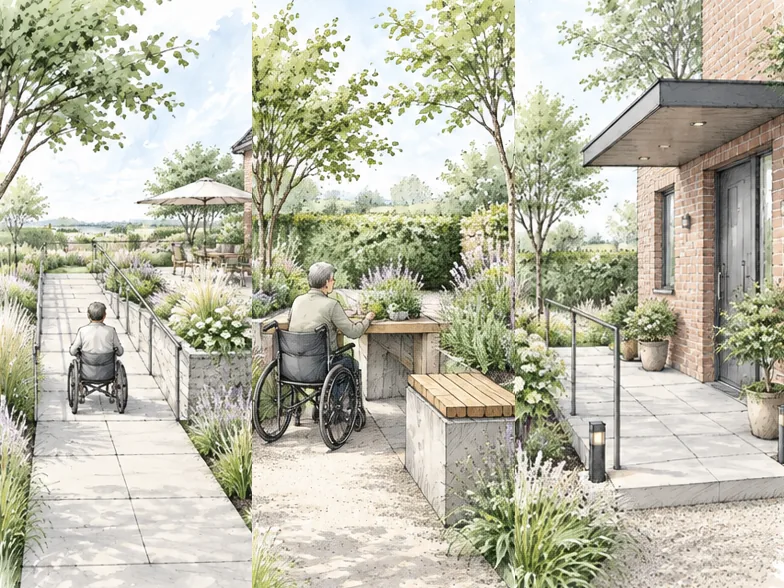
Wide paths with a firm surface link the house, patio, beds and garden gate. Where levels change, we build gentle ramps. If you like, we set them beside a flight of steps for anyone who prefers to use steps.
A garden you can use on your own, whether with a wheelchair, a rollator or simply as you get older. We plan and build wide, level paths, gentle ramps, step-free patios and raised beds at a comfortable height, as a landscaping firm based in Tangstedt.
Accessible does not just mean suitable for wheelchairs. A garden without steps, thresholds and trip edges helps anyone who is less steady on their feet or gets about with a rollator or walking stick. It helps families with prams just as much.
Many of our clients plan ahead. They want to be able to enjoy and look after their garden themselves in ten or twenty years' time. Others need a quick solution for the entrance and patio after an accident or illness.
A good accessible garden does not look clinical. Quality paving, planting and well-placed seating make a garden that is attractive and, almost as a side effect, easy to get around.
We give honest advice on what your situation really calls for. As landscapers, we build paths, ramps, patios and beds ourselves, so everything comes from one firm.
Many people have tended their garden with devotion for decades, until a step became too high, a gravel path too unsteady or a bed too low. Life then shifts to the patio, and later to the window. The garden becomes a view rather than a place to do things. Yet it often takes very little to win it back: a firm, level path, a gentle ramp in place of two steps, a raised bed at table height.
Accessibility sounds like standards and regulations. In the garden it mostly means quality of life: for older people, for wheelchair users, but also for families with prams or anyone who wants to get outside with a leg in plaster. An accessible garden is not a hospital garden. It is simply a garden that works for everyone.
In the suburbs of Hamburg and in the Pinneberg district, many people have lived in their own homes for decades. If you want to stay independent there for a long time, it pays to adapt the garden ahead of need: when the patio is being renewed anyway or the driveway is being repaved. A step-free threshold or a wider path then costs hardly any more, and it is ready before you urgently need it.
These three points decide whether a garden can really be used without help day to day.
 AI · AI-generated
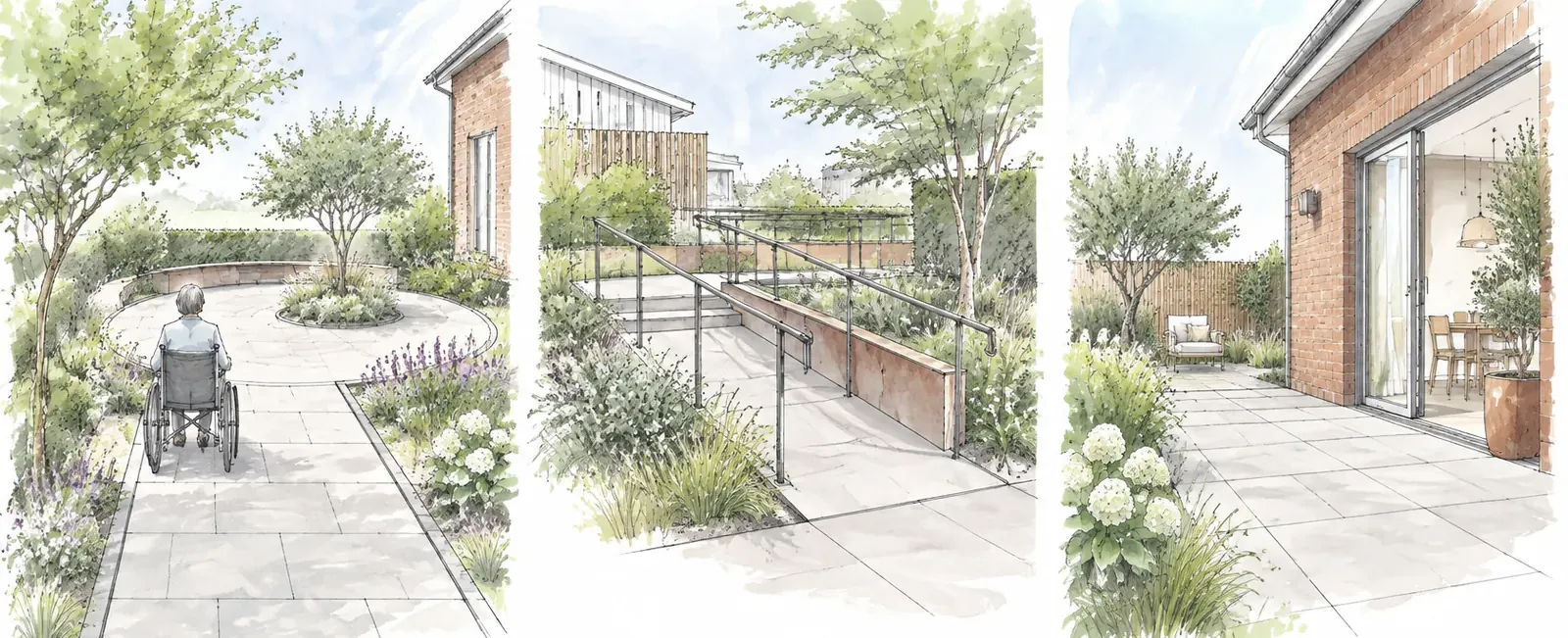
A main path should be at least 1.20 m wide, with a turning space of about 1.50 × 1.50 m at corners. We plan ramps with a gradient of no more than 6%, an intermediate landing and a handrail. The patio meets the door without a threshold.
Main paths are at least 1.20 metres wide. At corners and path ends there are turning spaces of about 1.50 × 1.50 metres for wheelchairs and rollators.
Ramps with a gradient of no more than about 6% take care of changes in level. They have intermediate landings, raised side edges and a handrail.
Block paving and slabs with tight joints and a slip-resistant surface are safe to wheel over. Loose gravel or bark mulch is unsuitable for main paths.
DIN 18040 is the reference for accessible outdoor spaces. It is not mandatory for private gardens, but its figures have proved themselves in practice.
Then there are the details you only notice when they are missing: high-contrast edges for people with impaired vision, slip-resistant surfaces, and lighting that shows steps and path edges clearly without dazzling.
AI · AI-generatedWide paths with a firm surface link the house, patio, beds and garden gate. Where levels change, we build gentle ramps. If you like, we set them beside a flight of steps for anyone who prefers to use steps.
 AI · AI-generated
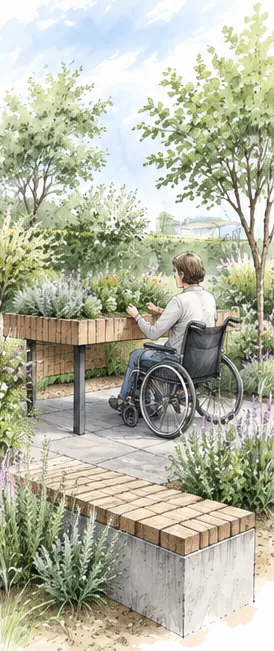
Gardening without bending: raised beds at the right height, wheelchair-accessible on request, with an edge to sit and rest on. Your own vegetable or herb bed stays within reach.
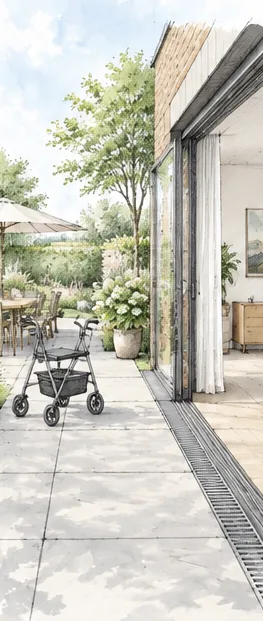 AI · AI-generated
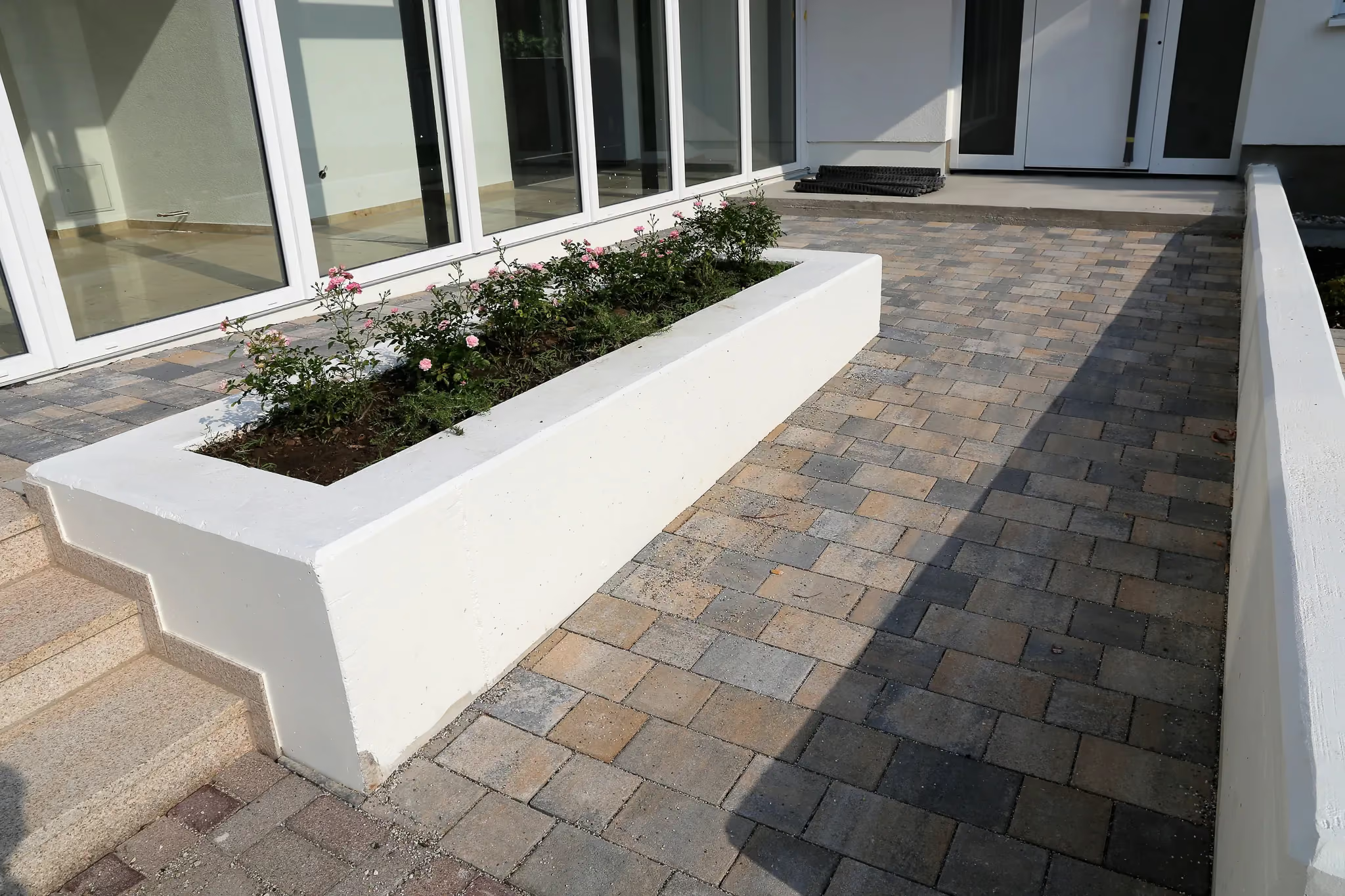
The patio sits level with the floor inside and meets the patio door without a step. A drainage channel in front of the door makes sure rainwater still stays out of the house.
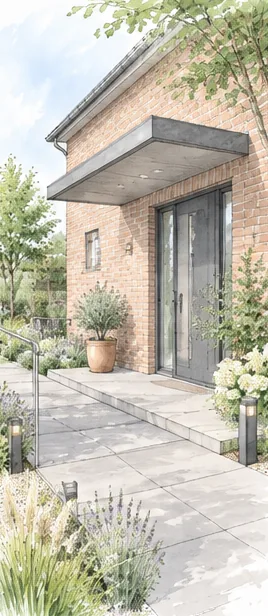 AI · AI-generated
From the pavement to the front door: gentle approaches, handrails, good lighting and clearly visible edges make the entrance safe by day and by night.
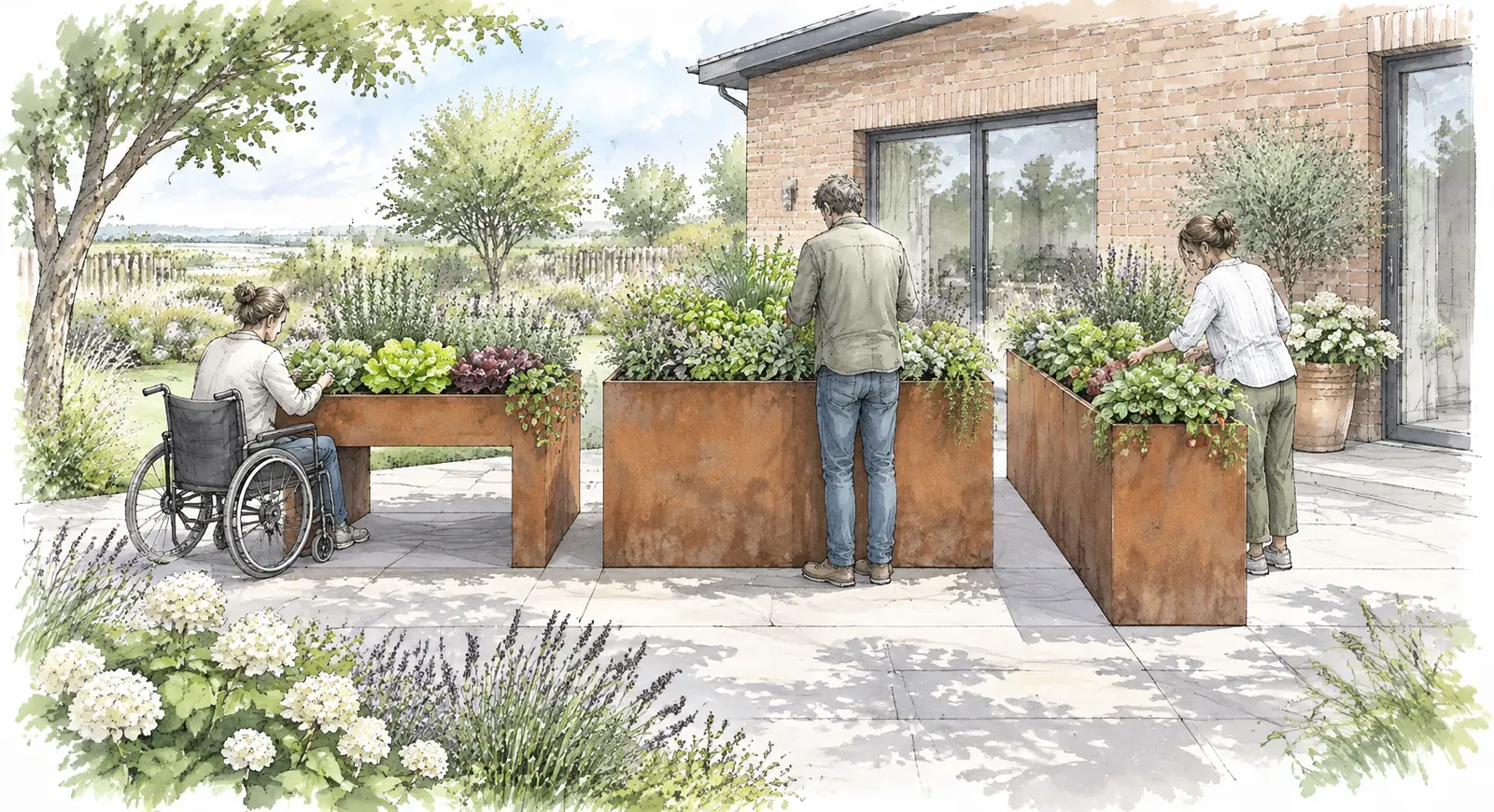 AI · AI-generated
A wheelchair-accessible raised bed about 70 cm high leaves room for your knees when you sit in a wheelchair. For working standing up, 85 to 95 cm is comfortable. From one side you can reach a good 60 cm in. Narrow beds, or beds you can get to from both sides, save you stretching.
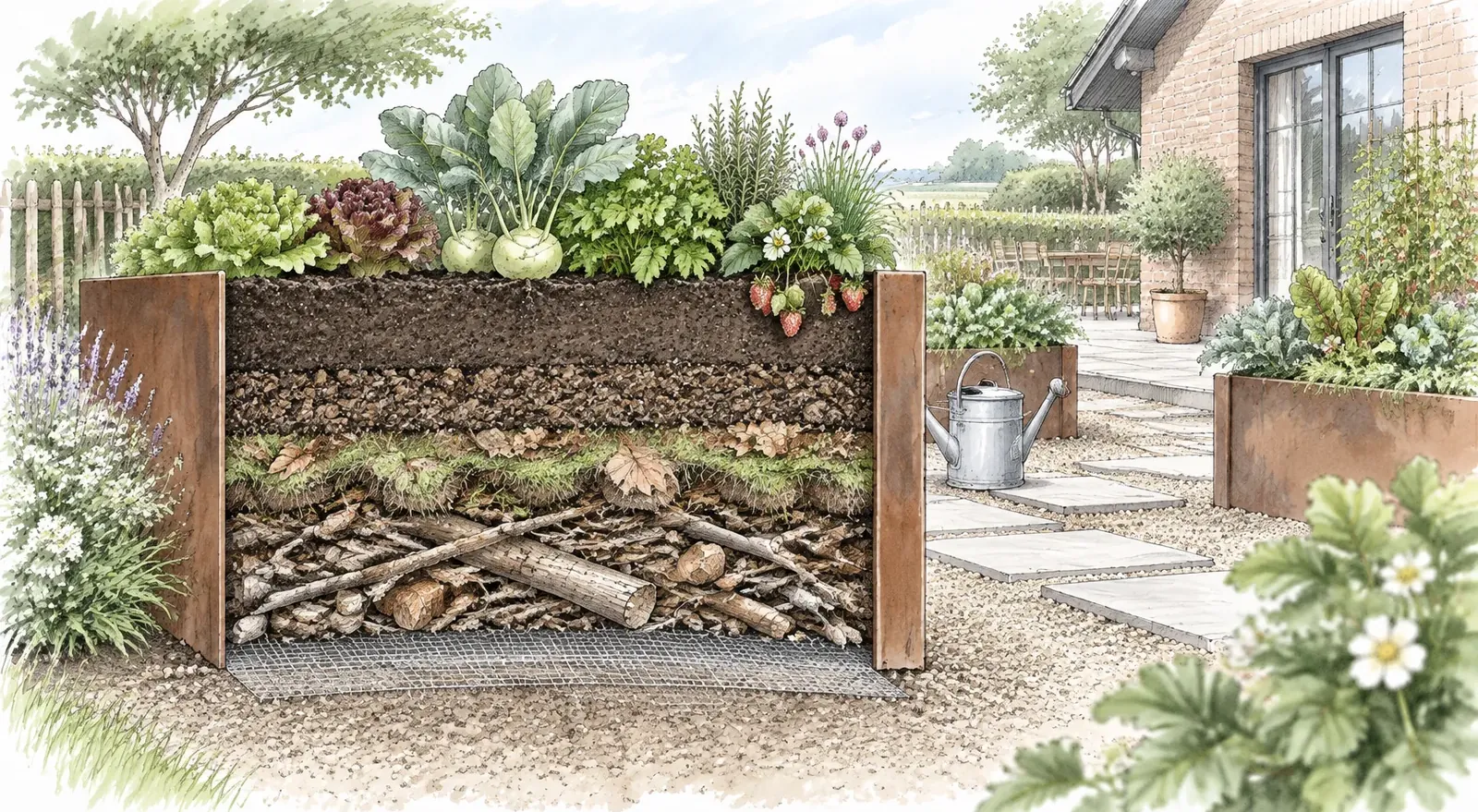 AI · AI-generated
Coarse at the bottom, fine at the top. Vole mesh keeps rodents out, and branches and prunings provide drainage. Next come upturned turves and leaves, which rot down slowly and release nutrients, then compost and good planting soil. Because the lower layers settle, the soil is topped up in the second year.
Scented herbs and perennials, grasses to touch, a water feature or rustling leaves let people with impaired vision experience the garden too. High-contrast edges help with orientation.
Tough perennials, ground cover, and shrubs and trees that need little pruning keep the work down. Automatic irrigation takes care of the watering, which is especially handy for raised beds.
An accessible garden can be more than practical. When seeing or walking becomes harder, the other senses matter more. Lavender, mint and roses at hand height release their scent as you brush past. Grasses rustle in the wind, and a small rill trickles along and helps you find your way. Different surfaces, such as smooth stone, warm timber and soft lawn, let you feel where the paths are.
We also think of people with dementia when we plan. Circular paths without dead ends, familiar plants from their younger days and seating that is easy to see give security and orientation.
Check funding: If you have a recognised care level (Pflegegrad), the long-term care insurance fund (Pflegekasse) can subsidise measures that improve the home environment, such as a ramp at the front door. From time to time the KfW development bank also runs programmes for removing barriers. Important: always apply before work starts. We will give you a detailed quote for the application.
Often it is small things that become obstacles in daily life. Good planning avoids them.
What a car can still manage is barely possible in a wheelchair. A gentler, slightly longer ramp with landings is safer.
Even a few centimetres' difference in level is an obstacle. The patio should sit level with the floor inside.
A narrow path that ends in a dead end forces you to reverse. Turning spaces at corners and ends give you room to manoeuvre.
Smooth surfaces, loose stones and missing lighting raise the risk of falls. Slip-resistant surfaces and lights along paths and steps help.
We look at your garden and talk about your daily routine, the routes you use and what is difficult today or may become so later.
We draw in paths, ramps, patio and beds with the dimensions they need and prepare a quote, split into construction stages if you wish.
We excavate paths and other areas and give them a load-bearing, well-compacted sub-base so that nothing sinks.
We build ramps, paths and patio with a level, slip-resistant surface, drainage channels and neat junctions.
We install raised beds, handrails, seating and lighting, and lay the cables and pipes for light and water at the same time.
We plant, tidy up and walk through the finished garden with you.
Every garden and every situation is different. Who uses the garden, with which aids, and what should they be able to do unaided? The answers give us path widths, ramps and heights.
You may be eligible for grants, for example from the long-term care insurance fund (Pflegekasse) if you have a recognised care level, or from funding programmes for age-appropriate conversions. It is best to check this before you place an order. We are happy to supply the details you need.
A garden that is easy to get around should also be easy to look after. So we like to combine accessible paths and beds with features that take work off your hands.
Firm surfaces, tough plants and irrigation keep upkeep low. That leaves more time to enjoy the garden.
The cost depends on how much needs to change: differences in level, path lengths, surfacing and fittings. It often makes sense to start with the entrance and patio. The ranges below are a guide. We give you an exact price after the site visit.
 AI · AI-generated
Not every garden needs to be built from scratch. Often it is enough to widen the main paths, replace a step with a ramp or raise the patio to door level.
The patio is often the key. Once it meets the house without a threshold, the garden becomes easier to use straight away. You can read more on our patio construction page.
More about patio construction ⟶For wheelchairs and rollators, main paths should be at least 1.20 metres wide. Turning spaces of about 1.50 × 1.50 metres are a good idea at corners and path ends.
As a guide, the gradient should be no more than about 6 per cent, which is a rise of 6 centimetres over one metre of length. On longer ramps, intermediate landings and handrails are important.
Block paving and slabs with a level, slip-resistant surface and tight joints. Loose surfaces such as gravel, grit or bark mulch are unsuitable for main paths.
A height of around 70 centimetres usually works if the bed is wheelchair-accessible. Taller beds are more comfortable for working standing up. We agree the height with you.
There can be, for example from the long-term care insurance fund (Pflegekasse) if you have a recognised care level, or from funding programmes for age-appropriate conversions. Please check the conditions before you place the order.
Yes. Targeted measures are often enough, such as a ramp at the entrance, a step-free patio and wider paths. We can build in stages if you wish.
No. With quality paving, planting and well-designed seating, the garden feels homely. At its best, you do not notice the accessibility at all.
In Hamburg, mainly in the west and north, and in the Pinneberg district: Pinneberg, Halstenbek, Rellingen, Wedel, Quickborn, Schenefeld and Tangstedt.
Tell us about your situation and your garden, ideally with photos. We will get back to you and arrange a site visit.